4 Best NAS Hard Drives Under $500, Compared
As an Amazon Associate we earn from qualifying purchases. Links on this page are affiliate links.
Finding the right NAS hard drive under 500 requires balancing storage capacity, spindle speed, and cache size. We compared 4 drives based on the specifications published on their listings to identify the best options for your server.
The Toshiba 16TB Enterprise 7200 RPM Hard Drive leads the group with its 16TB CMR capacity, 7200 RPM rotational speed, and 512 MiB cache designed for continuous multi-bay operation. This guide helps you choose the right model for your network storage demands and hardware requirements.
Quick picks
| # | Product | Best for | Price |
|---|---|---|---|
| 1 | Toshiba 16TB Enterprise 7200 RPM Hard Drive Best premium | high-capacity continuous 24/7 NAS arrays | Check price of Toshiba 16TB Enterprise 7200 RPM Hard Drive on Amazon |
| 2 | Western Digital Ultrastar 18TB CMR HDD (Renewed) Also great | high-density enterprise NAS storage arrays | Check price of Western Digital Ultrastar 18TB CMR HDD (Renewed) on Amazon |
| 3 | Seagate Exos X16 16TB SATA HDD Also great | high-capacity 16TB enterprise NAS deployments | Check price of Seagate Exos X16 16TB SATA HDD on Amazon |
| 4 | Seagate Exos X16 16TB Enterprise HDD Also great | high-capacity multi-bay enterprise NAS systems | Check price of Seagate Exos X16 16TB Enterprise HDD on Amazon |
The best fit for you
- You need the largest cache for continuous arrays Toshiba 16TB Enterprise 7200 RPM Hard Drive It provides a 512 MiB cache and 7200 RPM rotational speed for multi-bay arrays.
- You want the highest storage capacity available Western Digital Ultrastar 18TB CMR HDD (Renewed) It offers 18TB of CMR storage and transfer speeds up to 262 MB/s.
- You need the longest warranty coverage for arrays Seagate Exos X16 16TB Enterprise HDD It features a 5-year warranty alongside a 2.5 million hour MTBF rating.
Our 4 picks

Toshiba 16TB Enterprise 7200 RPM Hard Drive
Best for: high-capacity continuous 24/7 NAS arrays
- Storage Capacity
- 16 TB
- Form Factor
- 3.5"
- Hardware Interface
- SATA 6 Gb/s
- Rotational Speed
- 7200 RPM
- Cache Size
- 512 MiB
- Recording Technology
- CMR
This renewed Toshiba drive gives you 16TB of conventional magnetic recording storage on a standard SATA interface. It features a 7200 RPM spindle speed, a 512 MiB cache, and a helium-sealed nine-platter design. Rated for continuous operation with a 550 TB per year workload limit and rotational vibration sensors, this drive fits multi-bay server setups and NAS enclosures where you need large capacity alongside enterprise-grade data protection.
Pros
- 16TB capacity using conventional magnetic recording (CMR)
- Large 512 MiB cache paired with 7200 RPM speed
- Rated for up to 550 TB/year enterprise workload
- Built-in rotational vibration sensors and persistent write cache
- Helium-sealed nine-platter design
Cons
- Comes as a renewed drive rather than brand new
- Uses 512e emulation rather than native 4Kn formatting
Good fit if
- You need 16TB capacity with a large 512 MiB cache for high-demand storage.
- You operate multi-bay storage arrays that require rotational vibration sensors.
- You need enterprise continuous reliability backed by a 550 TB/year workload rating.
Skip if
- You want brand-new hardware rather than a renewed storage drive.
- You require native 4Kn sector sizing directly out of the box.
Verdict: Toshiba 16TB Enterprise 7200 RPM Hard Drive delivers massive CMR capacity, a 512 MiB cache, and enterprise-tier endurance for high-demand arrays. It suits continuous multi-bay operation where sustained performance and vibration protection are critical.
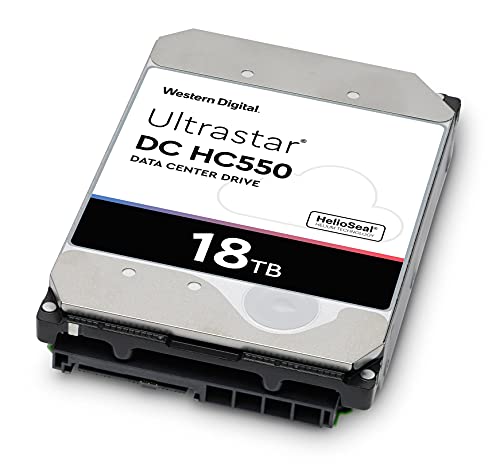
Western Digital Ultrastar 18TB CMR HDD (Renewed)
Best for: high-density enterprise NAS storage arrays
- Storage Capacity
- 18TB
- Form Factor
- 3.5-inch
- Hardware Interface
- SATA 6Gb/s
- Rotational Speed
- 7200 RPM
- Cache Size
- 512MB
- Recording Technology
- CMR
View on Amazon: Western Digital Ultrastar 18TB CMR HDD (Renewed)
This renewed Western Digital 18TB drive provides high capacity for your storage pool. It uses Conventional Magnetic Recording (CMR) to ensure consistent throughput, paired with a 7200 RPM spindle speed and a large 512MB cache buffer. The helium-sealed 3.5-inch design transfers data at rates up to 262 MB/s. It suits you if you need maximum drive density and enterprise-level sustained write speeds for multi-bay storage environments.
Pros
- 18TB capacity on a helium-sealed 3.5-inch platform
- Conventional Magnetic Recording (CMR) for predictable performance
- 7200 RPM speed with sustained transfer rates up to 262 MB/s
- 512MB cache buffer paired with a 512e sector format
- Pin-3 Power Disable feature supports hot-plugging
Cons
- Renewed product rather than factory-new
- Pin-3 Power Disable may require compatible SATA power connectors
Good fit if
- You need 18TB capacity per slot for high-density storage
- You require sustained CMR write performance for heavy workloads
- You run hardware that supports Pin-3 Power Disable features
Skip if
- You insist on buying factory-new hard drives
- You use legacy SATA power connections without Pin-3 support
Verdict: Western Digital Ultrastar 18TB CMR HDD (Renewed) delivers massive capacity and fast 262 MB/s transfer speeds for high-density systems. It provides enterprise CMR reliability if your power infrastructure accommodates Pin-3 Power Disable.

Seagate Exos X16 16TB SATA HDD
Best for: high-capacity 16TB enterprise NAS deployments
- Storage Capacity
- 16TB
- Form Factor
- 3.5-Inch
- Hardware Interface
- SATA 6Gb/s
- Rotational Speed
- 7200 RPM
- Cache Size
- 256MB
- Dimensions
- 5.79 × 4.01 × 1.03 inches
The Seagate Exos X16 16TB SATA HDD is a high-capacity 3.5-inch enterprise internal drive built for continuous storage environments. You get 16TB of storage, a 7200 RPM rotational speed, and a 256MB cache operating over a SATA 6Gb/s interface. Its helium-sealed architecture ensures uniform density, while the PowerBalance feature handles IOPS per watt efficiency. It suits you if you need dense, large-scale storage capacity.
Pros
- Helium-sealed drive design with uniform density
- 16TB capacity with 7200 RPM rotational speed
- 256MB cache on a SATA 6Gb/s interface
- PowerBalance feature enhances IOPS per watt
Cons
- Six-month replacement warranty period
- 3.5-inch form factor requires full-sized drive bays
Good fit if
- You need 16TB of storage capacity with 7200 RPM performance.
- You want a helium-sealed drive featuring PowerBalance efficiency.
Skip if
- You require a warranty period longer than six months.
- You need a 2.5-inch drive form factor.
Verdict: Seagate Exos X16 16TB SATA HDD delivers 16TB of helium-sealed storage at 7200 RPM for capacity-intensive NAS systems. Check that the six-month replacement warranty meets your hardware lifecycle requirements.

Seagate Exos X16 16TB Enterprise HDD
Best for: high-capacity multi-bay enterprise NAS systems
- Storage Capacity
- 16TB
- Form Factor
- 3.5-Inch
- Hardware Interface
- SATA 6Gb/s
- Rotational Speed
- 7200 RPM
- Cache Size
- 256MB
- Dimensions
- 5.79 × 4.01 × 1.03 inches
The Seagate Exos X16 16TB Enterprise HDD is a 3.5-inch internal hard drive designed for high-density network storage. It runs at 7200 RPM across a SATA 6Gb/s interface and includes a 256MB cache with support for 512e and 4Kn formats. With a 2.5 million hour MTBF and a 5-year limited warranty, it gives you reliable continuous operation for large-scale data applications and multi-bay enclosures across 2026.
Pros
- 7200 RPM spindle speed with a 256MB cache
- 2.5 million hour MTBF rating for continuous operation
- 5-year limited manufacturer warranty coverage
- Supports both 512e and 4Kn sector formats
Cons
- 3.5-inch form factor does not fit compact 2.5-inch drive slots
- Weight of 1.48 pounds adds mass in fully populated multi-bay chassis
Good fit if
- You need 16TB capacity per bay for dense storage arrays.
- You require 7200 RPM rotational speed paired with a 256MB cache.
- You want enterprise reliability backed by a 2.5 million hour MTBF.
Skip if
- You need a smaller 2.5-inch drive for compact NAS units.
- You require a non-SATA drive interface for your storage system.
Verdict: Seagate Exos X16 16TB Enterprise HDD delivers 7200 RPM enterprise throughput and a 2.5 million hour MTBF rating for demanding network environments. Its 256MB cache and 5-year warranty make it a solid choice for continuous multi-drive arrays.
Specifications side by side
| Spec | Toshiba 16TB Enterprise 7200 RPM Hard Drive | Western Digital Ultrastar 18TB CMR HDD (Renewed) | Seagate Exos X16 16TB SATA HDD | Seagate Exos X16 16TB Enterprise HDD |
|---|---|---|---|---|
| Storage Capacity | 16 TB | 18TB | 16TB | 16TB |
| Form Factor | 3.5" | 3.5-inch | 3.5-Inch | 3.5-Inch |
| Hardware Interface | SATA 6 Gb/s | SATA 6Gb/s | SATA 6Gb/s | SATA 6Gb/s |
| Rotational Speed | 7200 RPM | 7200 RPM | 7200 RPM | 7200 RPM |
| Cache Size | 512 MiB | 512MB | 256MB | 256MB |
| Recording Technology | CMR | CMR | not specified | not specified |
| Workload Rate Limit | up to 550 TB/year | not specified | not specified | not specified |
| Dimensions | 5.8 × 4 × 1 inches | 5.79 × 4 × 1.03 inches | 5.79 × 4.01 × 1.03 inches | 5.79 × 4.01 × 1.03 inches |
| Weight | 1.32 pounds | not specified | 1.4 pounds | 1.48 pounds |
| Size | 16TB | 18TB | 16TB | 1 TB |
| Color | Silver | Silver | Silver | Black |
| Model | MG08ACA16TE | WUH721818ALE6L4 | ST16000NM001G | ST16000NM000J |
Trade-offs to consider Under $500
All 4 drives in this category provide high capacities between 16TB and 18TB with SATA interfaces and 7200 RPM rotational speeds. You trade off variety in basic drive architecture. Every drive requires a standard 3.5-inch desktop bay, leaving out smaller form factor builds. Cache sizes top out at 512 MiB, with multiple drives capped at 256MB cache. You also find strict interface limitations, as all models rely exclusively on standard SATA connections rather than alternate enterprise interface options.
- Hardware Interface: limited exclusively to SATA
- Form Factor: restricted to 3.5-inch desktop bays
- Cache Size: capped between 256MB and 512 MiB
- Rotational Speed: fixed at 7200 RPM across models
If you require backup power to prevent data loss during an outage, specifications for a generator under 500 list wattage ratings and runtime figures.
How We Selected These Drives
This guide features 4 hard drives filtered from listings that match Under $500. You see only one capacity or model variant per drive line to ensure a balanced comparison. The list orders products in stock first, then by Amazon sales rank, showing better-selling products first.
Every comparison relies entirely on published manufacturer specifications and listing technical data. We do not physically handle or benchmark drives. Because pricing and stock status refresh daily on the page, drives enter or leave this guide whenever their prices move across the Under $500 limit.
Choosing the Best NAS Hard Drive
-
Select an Adequate Cache Buffer
Check the onboard cache size. Large cache buffers handle random burst operations and heavy multi-user NAS traffic smoothly. A 256MB cache works well for standard continuous file storage. If your NAS experiences frequent simultaneous read and write requests, look for a larger buffer. The Toshiba 16TB Enterprise Hard Drive includes a 512 MiB cache to manage high-demand arrays during heavy workloads.
-
Prioritize Conventional Magnetic Recording
Verify the recording technology before selecting a drive for multi-bay storage. Conventional Magnetic Recording sustains consistent write speeds during continuous network writing and array rebuilds. Shingled Magnetic Recording drops performance significantly during parity recalculation operations. For NAS environments, prioritize CMR disks. The Western Digital Ultrastar 18TB CMR HDD uses enterprise CMR architecture, which ensures steady transfer rates when rebuilding degraded redundant arrays.
-
Assess Spindle Rotational Speed
Examine the drive spindle speed for data delivery requirements. Drives operating at 7200 RPM deliver higher sustained throughput and lower read latencies compared to slower rotational speeds. This performance suits high-concurrency environments and multi-client access. Keep in mind that faster rotation generates additional heat and acoustic vibration inside compact enclosures. Ensure your NAS enclosure features adequate active cooling before deploying multiple high-speed drives.
-
Review Manufacturer Warranty Coverage
Check the manufacturer warranty duration to match your hardware lifecycle schedule. Enterprise hard drives often include extended multi-year terms, but renewed or clearance units offer shorter windows. Shorter warranties require you to prepare spare drives in advance. The Seagate Exos X16 16TB SATA HDD comes with a six-month replacement warranty, so verify that this term fits your server maintenance plans.
-
Evaluate MTBF Reliability Ratings
Review the Mean Time Between Failures rating to evaluate continuous server stability. Enterprise storage drives publish MTBF ratings to measure expected component durability under 24/7 operating loads. Ratings exceeding two million hours indicate robust mechanics designed to withstand continuous vibrational stress. The Seagate Exos X16 16TB Enterprise HDD features a 2.5 million hour MTBF rating, making it suitable for always-on network environments.
Frequently asked questions
What rotational speed do enterprise NAS hard drives use?
Enterprise NAS drives commonly run at 7200 RPM to maximize continuous throughput. All options in this guide, including the Toshiba MG08ACA16TE and Western Digital Ultrastar WUH721818ALE6L4, spin at 7200 RPM. This higher rotational speed reduces read and write latency across multi-user networks. It also ensures faster file access times when your storage array handles simultaneous network requests from multiple connected client devices.
Are enterprise SATA hard drives compatible with standard NAS enclosures?
Yes, enterprise SATA drives generally fit standard 3.5-inch NAS drive trays. Units such as the Seagate Exos X16 ST16000NM001G share standard dimensions of 4.01 inches wide and 5.79 inches long. However, you must verify compatibility with specific power features. Drives like the Western Digital Ultrastar 18TB use Pin-3 Power Disable technology, which requires compatible backplanes or specialized power cabling to spin up correctly in consumer enclosures.
Why is CMR recording important for network attached storage?
Conventional Magnetic Recording writes data in discrete, non-overlapping tracks to maintain sustained transfer performance. Drives like the Toshiba 16TB Enterprise and Western Digital Ultrastar 18TB utilize CMR architecture. This prevents the severe write performance penalties that occur during intensive RAID rebuilds or heavy multi-bay writing. When you configure arrays for continuous operations, CMR ensures consistent data ingestion without unexpected throughput bottlenecks during long backup sessions.
What is MTBF and how does it apply to NAS hard drives?
Mean Time Between Failures measures the statistical reliability of a drive model during continuous operation. For instance, the Seagate Exos X16 ST16000NM000J features a 2.5 million hour MTBF rating. While MTBF does not guarantee an individual drive's exact lifespan, a higher rating indicates better engineering tolerances for 24/7 network workloads. It gives you an objective baseline to compare enterprise-grade build quality across different drive models.
How does hard drive cache size affect NAS performance?
Onboard drive cache holds frequently accessed data and write commands temporarily to accelerate overall storage operations. The Toshiba 16TB Enterprise drive features a 512 MiB cache, while models like the Seagate Exos X16 ST16000NM001G carry 256MB buffers. A larger cache helps your NAS handle sudden bursts of data traffic and concurrent user requests efficiently, preventing incoming transfers from backing up before data commits to physical platters.
What role does helium sealing play in high-capacity NAS drives?
Helium-sealed enclosures reduce internal turbulence, allowing drive platters to spin with less resistance. Drives like the Seagate Exos X16 16TB ST16000NM001G utilize sealed helium technology to pack multiple high-density platters inside standard 3.5-inch bays. Because helium creates less aerodynamic drag than ambient air, the drive requires less mechanical effort to spin at 7200 RPM. This design supports higher data capacities without expanding outer physical dimensions.
What transfer speeds can you expect from enterprise NAS drives?
Sustained transfer speeds on high-capacity enterprise hard drives typically reach over 250 MB/s for sequential tasks. For example, the Western Digital Ultrastar 18TB CMR HDD specifies transfer rates reaching up to 262 MB/s. These speeds maximize standard Gigabit or multi-Gigabit Ethernet connections during large file transfers. When you operate 7200 RPM drives in multi-bay configurations, sequential read and write speeds easily saturate baseline network interfaces.