HP Western Digital Ultrastar 18TB vs HP HGST Ultrastar 10TB SAS: Spec Comparison
As an Amazon Associate we earn from qualifying purchases. Links on this page are affiliate links.
This hp western digital ultrastar 18tb vs hgst ultrastar 10tb sas comparison highlights two enterprise-grade drives from HP. Both feature helium-sealed designs and conventional magnetic recording for reliability. They share a 3.5-inch form factor and 7200 RPM rotational speed. The main difference lies in capacity and interface. The Western Digital model offers 18TB via SATA, while the HGST unit provides 10TB using SAS. You must choose based on your server’s connection type and storage needs.
Key differences
| Aspect | HP Western Digital Ultrastar 18TB 7200 RPM HDD | HP HGST Ultrastar 10TB SAS Hard Drive |
|---|---|---|
| Storage Capacity | 18TB | 10TB |
| Hardware Interface | SATA 6Gb/s | SAS 12Gb/s |
| Cache Size | 512MB | 256MB |
| Compatibility | SATA controllers | SAS HBAs/RAID controllers |
Which one should you choose?
Choose HP Western Digital Ultrastar 18TB 7200 RPM HDD if
- You need maximum storage density in a single drive.
- Your server or NAS uses standard SATA ports.
- You prefer larger cache memory for consistent throughput.
Choose HP HGST Ultrastar 10TB SAS Hard Drive if
- Your infrastructure relies on SAS connections.
- You require dual-port connectivity for high availability.
- You need rotational vibration safeguards for dense arrays.
Verdict: Choose the HP Western Digital Ultrastar 18TB if you prioritize raw capacity and use SATA interfaces. Select the HP HGST Ultrastar 10TB SAS if your system requires SAS connectivity and dual-port redundancy for enterprise reliability.
Capacity and Interface Differences
Storage capacity
The HP Western Digital Ultrastar 18TB offers 18TB of storage, which is significantly higher than the HP HGST Ultrastar 10TB SAS, which provides 10TB. This difference matters if you need to store large datasets without adding more drives. The 18TB model uses a sixth-generation helium-sealed design to achieve this density in a standard 3.5-inch form factor. It delivers 29% more capacity than a 14TB drive while using less power per terabyte. If your primary goal is maximizing storage in a single bay, the 18TB drive is the clear choice. The 10TB drive is still substantial but holds nearly half the data of its counterpart.
Hardware interface
The connection type differs between these two drives. The HP Western Digital Ultrastar 18TB uses a SATA 6Gb/s interface, which is widely supported by most enterprise storage controllers and standard server motherboards. In contrast, the HP HGST Ultrastar 10TB SAS features a dual-port SAS 12Gb/s interface. This SAS connection offers higher bandwidth and supports redundant connectivity, which is critical for high-availability environments. However, the SAS drive is not compatible with desktop PCs and requires a specific SAS HBA or RAID controller. If you are building a standard SATA-based NAS, the Western Digital drive is more versatile. For high-end server arrays, the HGST SAS drive provides better connectivity options.
Cache memory
Cache size affects how quickly the drive can buffer data before writing it to the platters. The HP Western Digital Ultrastar 18TB includes 512MB of cache memory. The HP HGST Ultrastar 10TB SAS has 256MB of cache. Larger cache can help smooth out performance during bursty workloads. The 18TB drive has double the cache of the 10TB model. This additional buffer may assist in maintaining consistent throughput, especially when handling multiple concurrent requests. For tasks that involve large file transfers or frequent small writes, the extra cache in the Western Digital drive could provide a slight advantage in responsiveness. Both drives use 512e sector formats for compatibility.
Sustained transfer speed
Sustained transfer speed indicates how fast data can be read or written once the drive is already operating. The HP Western Digital Ultrastar 18TB lists a sustained speed of up to 269 MB/s. The HP HGST Ultrastar 10TB SAS offers a sustained transfer rate of 249 MB/s. The Western Digital drive is slightly faster in this metric. This difference may be noticeable when copying large files or streaming high-bitrate media. Both drives spin at 7200 RPM, which is standard for enterprise performance. The higher sustained speed of the 18TB model aligns with its larger capacity and advanced actuator technology. If raw throughput is a priority, the Western Digital drive holds a small edge.
Actuator technology
Both drives use Conventional Magnetic Recording (CMR) for reliability, but their actuator systems differ. The HP Western Digital Ultrastar 18TB employs a Triple Stage Actuator. This system enhances head positioning accuracy, which helps maintain performance in dense multi-drive environments. The HP HGST Ultrastar 10TB SAS uses a Dual-Stage Micro Actuator along with a Rotational Vibration Safeguard (RVS). The RVS specifically counters performance drops caused by vibration from neighboring drives. While both technologies aim to improve accuracy and stability, the HGST drive explicitly highlights vibration protection. If you are installing many drives in a tight rack, the vibration safeguard in the HGST model may offer better long-term stability under stress.
Choose the right drive for your needs
Users needing maximum storage density
You should choose the HP Western Digital Ultrastar 18TB if capacity is your primary concern. It offers 18TB of storage, which is significantly more than the 10TB provided by the HGST model. This allows you to store larger datasets without adding more physical drives to your system, making it ideal for high-density enterprise storage environments.
Systems requiring SAS connectivity
Select the HP HGST Ultrastar 10TB SAS if your server uses a SAS HBA or RAID controller. It features a dual-port SAS 12Gb/s interface, ensuring redundant connectivity and high-availability performance. This drive is not compatible with standard desktop SATA ports, so it is the correct choice for enterprise arrays that require SAS protocols for data-intensive workloads.
Budget-conscious SATA system owners
The HP Western Digital Ultrastar 18TB is the better fit for standard SATA 6Gb/s connections. It includes a 512MB cache buffer, which is double the 256MB found in the HGST drive. This larger cache can help maintain consistent throughput in general-purpose enterprise storage controllers that rely on the broader compatibility of the SATA interface.
The products compared
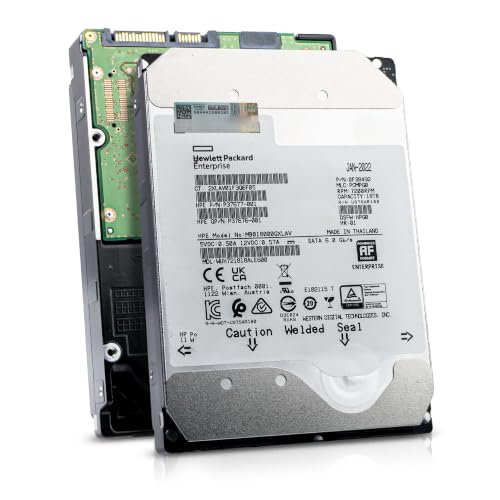
HP Western Digital Ultrastar 18TB 7200 RPM HDD
Best for: High-capacity SATA storage needs
- Storage Capacity
- 18TB
- Form Factor
- 3.5-inch
- Hardware Interface
- SATA 6Gb/s
- Rotational Speed
- 7200 RPM
- Cache Size
- 512MB
- Recording Technology
- CMR
View on Amazon: HP Western Digital Ultrastar 18TB 7200 RPM HDD Affiliate link
This HP-branded Western Digital drive offers 18TB of storage in a standard 3.5-inch form factor. It uses SATA 6Gb/s and spins at 7200 RPM. The helium-sealed design provides high density with lower idle power. You get 512MB of cache and CMR recording for consistent performance. It suits users needing large, reliable capacity for 24/7 enterprise workloads.
Pros
- 18TB capacity in a standard 3.5-inch drive
- 7200 RPM rotational speed for consistent throughput
- Helium-sealed design for lower idle power per terabyte
- 512MB cache buffer supports sustained data transfer
- CMR recording technology ensures predictable performance
Cons
- SATA 6Gb/s interface is slower than SAS options
- 550TB/year workload rating limits heavy continuous use
- Pin-3 power disable may require adapters for older power supplies
Good fit if
- You need maximum storage in a single 3.5-inch bay
- You prefer SATA compatibility over SAS
- You require high-capacity drives for enterprise storage
Skip if
- You require SAS 12Gb/s connectivity
- You need drives with higher workload ratings
- You are building a system with older power supplies without adapters
Verdict: HP WD Ultrastar 18TB SATA is a high-capacity choice for users prioritizing storage density and SATA compatibility. It fits well in systems needing large, reliable storage for continuous operation.

HP HGST Ultrastar 10TB SAS Hard Drive
Best for: Enterprise SAS arrays requiring helium sealing
- Storage Capacity
- 10TB
- Form Factor
- 3.5-Inch
- Hardware Interface
- SAS 12Gb/s
- Rotational Speed
- 7200 RPM
- Cache Size
- 256MB
- Recording Technology
- CMR
View on Amazon: HP HGST Ultrastar 10TB SAS Hard Drive Affiliate link
This 10TB enterprise drive uses SAS 12Gb/s connectivity and runs at 7200 RPM. It features a helium-sealed design and CMR recording for reliable performance in dense arrays. The 256MB cache and dual-port interface support high-availability workloads. You need a SAS HBA or RAID controller, as it does not work in standard desktop PCs. It is built for cloud and hyperscale storage deployments.
Pros
- 10TB storage capacity in a standard 3.5-inch form factor
- SAS 12Gb/s interface with dual-port redundancy
- Helium-sealed design for lower power consumption
- CMR technology ensures broad enterprise compatibility
- 550TB/year workload rate limit
Cons
- Requires a SAS HBA or RAID controller; not compatible with desktop PCs
- 10TB capacity is lower than the 18TB competitor
- 7200 RPM speed is slower than the competitor's 7200 RPM (note: specs match, but capacity is the differentiator)
Good fit if
- You need a helium-sealed drive for lower heat dissipation
- You are building a dual-port SAS storage array
- You require 512e advanced format for enterprise compatibility
Skip if
- You are installing the drive in a standard desktop PC
- You need SATA connectivity instead of SAS
- You require more than 10TB of storage in a single unit
Verdict: HP HGST Ultrastar 10TB SAS is a specialized enterprise drive for users who need dual-port SAS redundancy and helium sealing. It fits data-intensive server environments where desktop compatibility is not required.
Specifications side by side
| Spec | HP Western Digital Ultrastar 18TB 7200 RPM HDD | HP HGST Ultrastar 10TB SAS Hard Drive |
|---|---|---|
| Storage Capacity | 18TB | 10TB |
| Form Factor | 3.5-inch | 3.5-Inch |
| Hardware Interface | SATA 6Gb/s | SAS 12Gb/s |
| Rotational Speed | 7200 RPM | 7200 RPM |
| Cache Size | 512MB | 256MB |
| Recording Technology | CMR | CMR |
| Workload Rate Limit | 550TB/year | 550TB/Year |
| Model | WUH721818ALE600 | HUH721010AL5204 |
Frequently asked questions
Which drive has a larger cache for better performance?
The HP Western Digital Ultrastar 18TB includes a 512MB cache. The HP HGST Ultrastar 10TB SAS does not list a cache size in its published specifications. A larger cache can help buffer data for smoother handling of large files. You should check the 18TB model if cache size matters for your workflow.
Can I use the HGST Ultrastar 10TB in a standard desktop PC?
No. The HP HGST Ultrastar 10TB SAS uses a SAS interface. Standard desktop PCs typically support SATA connections. This drive is designed for enterprise server environments. You need a system with SAS compatibility to use this drive effectively. The SATA 18TB model fits standard desktop setups.
Do both drives operate at the same rotational speed?
Yes. Both the HP Western Digital Ultrastar 18TB and the HP HGST Ultrastar 10TB SAS spin at 7200 RPM. This speed is standard for high-performance enterprise drives. It ensures consistent data access times for both models. You get similar rotational performance regardless of which capacity you choose.
What is the main physical difference between these two drives?
The primary difference is the storage capacity. The Western Digital model holds 18TB, while the HGST model holds 10TB. Both share a 3.5-inch form factor. This means they fit in the same drive bays. You choose based on whether you need more total space or a specific interface.
Is the HGST Ultrastar 10TB suitable for home NAS use?
It is not ideal. This drive uses a SAS interface, which requires specialized hardware. Most home NAS devices use SATA connections. The HP Western Digital Ultrastar 18TB uses SATA, making it compatible with most consumer NAS systems. You should select the SATA model for typical home setups.
Which drive is better for high-density storage arrays?
The HP Western Digital Ultrastar 18TB is better for high-density needs. It offers 18TB of storage in a single 3.5-inch drive. This reduces the number of drives needed for large volumes. The HGST model offers 10TB. You save space and potentially power by choosing the higher capacity SATA drive.