QNAP 4-Bay 2.5GbE NAS Enclosure vs QNAP 2-Bay Desktop NAS Dual: Spec Comparison
As an Amazon Associate we earn from qualifying purchases. Links on this page are affiliate links.
The qnap ts 433 4g us storage NAS vs ts 253e 8g us 2 bay desktop comparison highlights two distinct storage solutions. Both devices offer robust networking with 2.5GbE ports and support for four drive bays in the TS-433. The main difference lies in their architecture. The TS-433 uses an ARM processor with 4GB of RAM. The TS-253E features an Intel quad-core CPU and 8GB of RAM. This impacts performance and expandability options significantly.
Key differences
| Aspect | QNAP 4-Bay 2.5GbE NAS Enclosure | QNAP 2-Bay Desktop NAS with Dual 2.5GbE |
|---|---|---|
| Form Factor | Tower | Desktop |
| Processor | 2.0GHz 4-core Cortex-A55 ARM | Intel Quad-core (burst up to 2.9 GHz) |
| RAM Capacity | 4GB built-in | 8GB |
| Drive Bays | 4 Bays | 2 Bays |
| Network Connectivity | 1x 2.5GbE | Dual 2.5GbE |
| M.2 NVMe Slots | not listed | 2 slots |
Which one should you choose?
Choose QNAP 4-Bay 2.5GbE NAS Enclosure if
- You need to store more data with four drive bays.
- You prefer a tower design for vertical space saving.
- You want a simpler setup with a single 2.5GbE port.
Choose QNAP 2-Bay Desktop NAS with Dual 2.5GbE if
- You require higher RAM capacity for multitasking.
- You need dual 2.5GbE ports for link aggregation.
- You want to use M.2 NVMe SSDs for caching or storage.
Verdict: The TS-433 suits users who prioritize raw storage capacity with four bays and a compact tower form factor. The TS-253E is better for those needing higher processing power, more RAM, and SSD caching options. Choose based on whether storage volume or performance features matter more to you.
Spec Comparison: Bays vs RAM
Number of Bays
The QNAP TS-433-4G-US offers four drive bays, allowing you to install up to four hard drives for expanded storage capacity. This tower-style enclosure supports a maximum capacity of 80TB when fully populated. In contrast, the QNAP TS-253E-8G-US is a two-bay desktop unit. It accommodates only two drives, limiting your maximum total storage potential compared to the four-bay model. If you need significant raw storage space for media libraries or backups, the four-bay TS-433 provides more physical slots for your drives.
RAM Capacity
Memory plays a key role in multitasking and application performance. The QNAP TS-433-4G-US comes with 4GB of built-in RAM. This is sufficient for basic file sharing and light virtualization tasks. However, the QNAP TS-253E-8G-US features 8GB of RAM, which is double the amount. The higher memory capacity in the TS-253E allows for smoother operation when running multiple containerized applications, heavier virtual machines, or more simultaneous user connections. For power users running complex services, the extra RAM is a clear advantage.
Processor Speed
Both units use quad-core processors, but their clock speeds differ significantly. The TS-433-4G-US utilizes a 2.0GHz ARM Cortex-A55 processor. This is an efficient chip designed for low power consumption and steady performance. The TS-253E-8G-US uses an Intel quad-core CPU that can burst up to 2.9 GHz. The higher clock speed and different architecture of the Intel chip in the TS-253E generally provide better raw processing power for demanding tasks like transcoding or heavy data encryption compared to the ARM-based TS-433.
Cache Acceleration
Storage speed can be improved with solid-state cache. The QNAP TS-253E-8G-US includes two M.2 PCIe Gen3x2 NVMe SSD slots. You can use these slots to create a cache pool or an SSD storage pool, which significantly speeds up read and write operations for frequently accessed files. The data for the QNAP TS-433-4G-US does not list any M.2 slots or NVMe support. Therefore, if you want to accelerate your NAS performance with fast SSDs, the TS-253E offers dedicated hardware for this purpose.
Network Ports
Both NAS devices feature 2.5GbE network connectivity to exceed standard Gigabit speeds. The QNAP TS-433-4G-US is equipped with a single 2.5Gigabit Ethernet port. This is sufficient for most home users who do not require link aggregation or failover. The QNAP TS-253E-8G-US, however, includes dual 2.5GbE ports. Having two ports allows you to bond them for increased throughput or set up link failover for reliability. This flexibility makes the TS-253E more suitable for users who need higher bandwidth or network redundancy.
Which NAS suits your storage needs
Users needing maximum raw capacity
The QNAP TS-433-4G-US features four drive bays, supporting up to 80TB of total storage when fully populated. This tower enclosure allows you to expand your library significantly. It includes a quad-core 2.0GHz processor and 4GB of built-in RAM to manage these larger volumes efficiently.
Professionals requiring fast data transfer speeds
The QNAP TS-253E-8G-US offers dual 2.5GbE ports to accelerate file sharing and large transfers across your network. It also includes two M.2 NVMe slots for cache acceleration or SSD storage pools. This setup ensures rapid access to files, making it ideal for high-performance workflows.
Those prioritizing RAM and CPU power
This model provides 8GB of RAM and an Intel quad-core CPU that bursts up to 2.9GHz. These specs support smoother multitasking and faster application performance compared to the competitor. The dual 2.5GbE ports further enhance network throughput for demanding tasks and heavy user loads.
Users wanting flexible USB connectivity
The QNAP TS-253E-8G-US includes multiple USB 3.2 Gen 2 ports with speeds up to 10Gb/s. This allows compatibility with newer, faster USB drives and expansion enclosures. You can transfer large media files quickly, adding versatile external storage options that the four-bay tower does not explicitly highlight.
The products compared

QNAP 4-Bay 2.5GbE NAS Enclosure
Best for: Users needing 4 bays and 2.5GbE networking
- Drive Bays
- 4 BAYS
- Network Connectivity
- 1x 2.5Gigabit Ethernet Port
- Processor
- 2.0GHz 4-core Cortex-A55 ARM
- RAM Capacity
- 4GB built-in
- Included Storage
- No HDD
- Processor Cores
- Quad-Core
View on Amazon: QNAP 4-Bay 2.5GbE NAS Enclosure Affiliate link
This QNAP NAS offers four drive bays for expanding storage up to 80TB. It uses a 2.0GHz quad-core Cortex-A55 ARM processor and includes 4GB of built-in RAM. The unit features a single 2.5GbE Ethernet port for faster local transfers. Its tower design allows for easy drive access. You should choose this model if you need more drive capacity than a two-bay system provides.
Pros
- Four drive bays support up to 80TB total capacity
- Quad-core Cortex-A55 ARM processor runs at 2.0GHz
- Includes 4GB of built-in RAM for multitasking
- Features a 2.5GbE Ethernet port for improved network speeds
Cons
- Only one 2.5GbE network port is included
- RAM capacity is lower than the competing 8GB model
- Does not include hard drives in the package
Good fit if
- You need to store large media libraries or many files
- You want faster local network transfers than 1GbE offers
- You prefer a tower design for easy drive installation
Skip if
- You need dual 2.5GbE ports for link aggregation
- You require more than 4GB of RAM for heavy virtualization
- You want a compact desktop form factor instead of a tower
Verdict: QNAP 4-Bay NAS with 2.5GbE fits users who need extra drive bays and faster networking than a basic two-bay unit. It is a practical step up for home servers that outgrow 2-bay storage limits.
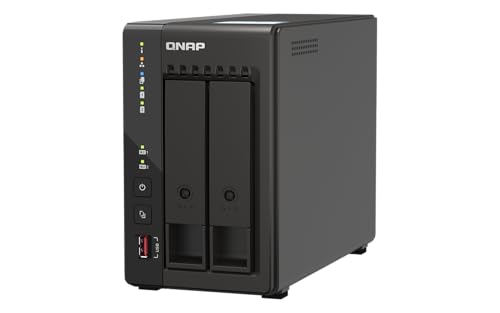
QNAP 2-Bay Desktop NAS with Dual 2.5GbE
Best for: Users needing 8GB RAM and NVMe support
- Drive Bays
- 2 Bay
- Network Connectivity
- Dual 2.5GbE
- Processor
- Intel Quad-core
- RAM Capacity
- 8GB
- M.2 NVMe Slots
- Dual M.2 PCIe Gen3x2 NVMe slots
- Included Storage
- Diskless
View on Amazon: QNAP 2-Bay Desktop NAS with Dual 2.5GbE Affiliate link
The QNAP TS-253E is a 2-bay desktop NAS featuring an Intel quad-core CPU and 8GB of RAM. It includes dual 2.5GbE ports for faster network transfers and two M.2 NVMe slots for cache or storage. This setup suits users needing ample memory and high-speed connectivity in a compact form factor.
Pros
- 8GB RAM capacity
- Dual 2.5GbE network ports
- Dual M.2 NVMe SSD slots
- Intel quad-core processor
Cons
- Only two drive bays
- Desktop form factor limits placement options
- No mention of built-in display or remote
Good fit if
- You need high RAM for virtualization
- You want fast 2.5GbE networking
- You plan to use NVMe drives
Skip if
- You require four drive bays
- You need a compact tower design
- You prefer 1GbE connectivity only
Verdict: QNAP TS-253E 2-Bay Desktop NAS offers strong specs for small teams. It fits users who prioritize RAM and speed over drive capacity.
Specifications side by side
| Spec | QNAP 4-Bay 2.5GbE NAS Enclosure | QNAP 2-Bay Desktop NAS with Dual 2.5GbE |
|---|---|---|
| Drive Bays | 4 BAYS | 2 Bay |
| Network Connectivity | 1x 2.5Gigabit Ethernet Port | Dual 2.5GbE |
| Processor | 2.0GHz 4-core Cortex-A55 ARM | Intel Quad-core |
| RAM Capacity | 4GB built-in | 8GB |
| M.2 NVMe Slots | not stated | Dual M.2 PCIe Gen3x2 NVMe slots |
| Included Storage | No HDD | Diskless |
| Form Factor | not stated | Desktop |
| Number of Bays | 4-Bay | 2-Bay |
| Processor Cores | Quad-Core | Quad-Core |
| Dimensions | 2.48 × 3.39 × 2.62 inches | not stated |
| Weight | 4.56 pounds | not stated |
| Color | White | Black |
| Model | TS-433-4G | not stated |
| Size | not stated | 2 Bay |
Frequently asked questions
Which NAS is better for home media servers?
The QNAP TS-433-4G-US is often better for home media servers due to its four drive bays. This allows you to store larger media libraries without filling up storage quickly. The white tower design also fits well in home entertainment centers, offering more capacity than the two-bay alternative.
Does the TS-253E support NVMe drives?
Yes, the QNAP TS-253E-8G-US supports NVMe drives. This feature is highlighted in its best-for description, which notes NVMe support as a key benefit. This allows for faster cache performance, making it a strong choice for users who prioritize speed and RAM over raw drive count.
What is the main difference in form factor?
The TS-433-4G-US is a 4-bay enclosure, while the TS-253E-8G-US is a 2-bay desktop unit. The TS-433 offers more physical space for hard drives, supporting up to four units. The TS-253E is designed as a compact desktop solution, focusing on processing power and memory rather than expansion slots.
Which model has more RAM capacity?
The QNAP TS-253E-8G-US features 8GB of RAM. This is explicitly mentioned in its product name and best-for description. In comparison, the TS-433-4G-US is listed with 4GB of RAM. More RAM can help handle more concurrent tasks and virtual machines efficiently.
Is the TS-433 suitable for small business use?
The TS-433-4G-US is suitable for small business use if you need extra drive bays. It provides a practical step up for home servers or small offices that outgrow 2-bay limits. Its quad-core processor and 2.5GbE networking offer solid performance for file sharing and basic server duties.
How do the network speeds compare?
Both units feature 2.5GbE networking ports. This means you get faster data transfer speeds compared to standard 1GbE connections on both models. The TS-433 includes this networking capability alongside its four bays, while the TS-253E pairs 2.5GbE with desktop form factor and higher RAM.
Which NAS is better for users prioritizing RAM?
The QNAP TS-253E-8G-US is better for users prioritizing RAM. It comes with 8GB of memory, which is double the 4GB found in the TS-433. This makes it ideal for workloads that require more memory for caching or running applications, even though it has fewer drive bays.
Can I expand storage on the TS-253E?
You can expand storage on the TS-253E-8G-US by filling its two drive bays. However, it offers less total capacity potential than the TS-433, which supports four drives. If you need maximum raw capacity, the four-bay TS-433 is the more flexible option for future growth.