QNAP or BUFFALO? NAS Devices Compared in 2026
As an Amazon Associate we earn from qualifying purchases. Links on this page are affiliate links.
This QNAP vs BUFFALO NAS device comparison highlights two distinct approaches to network storage. Both units provide centralized file sharing and backup capabilities for your home or office network. The main difference lies in their scale and target audience. QNAP offers a high-capacity, expandable system for power users, while BUFFALO provides a simple, pre-loaded solution for basic home storage needs. You should choose based on your required drive capacity and feature set.
Key differences
| Aspect | QNAP TS-673-4G 8-Bay NAS | BUFFALO LinkStation 210 2TB 1-Bay NAS |
|---|---|---|
| Number of Bays | 8-Bay | 1-Bay |
| RAM Capacity | 4GB RAM | not listed |
| Processor | AMD R-Series Quad-core 2.1GHz | not listed |
| Included Storage | not listed | 2TB |
| Network Ports | Four 1GbE Ports | not listed |
Which one should you choose?
Choose QNAP TS-673-4G 8-Bay NAS if
- You need to store large amounts of data across multiple drives.
- You require advanced features like virtualization, container apps, or 4K transcoding.
- You want the flexibility to add 10GbE networking or SSD caching later.
Choose BUFFALO LinkStation 210 2TB 1-Bay NAS if
- You want a simple plug-and-play device with a drive already installed.
- You only need a single drive for basic home file sharing and backups.
- You prefer a compact, lightweight unit that fits easily in small spaces.
Verdict: The QNAP TS-673-4G is the superior choice for users who need significant storage capacity, expansion options, and advanced computing features. The BUFFALO LinkStation 210 is better suited for individuals who want a hassle-free, entry-level storage solution with a drive included.
QNAP vs BUFFALO NAS Showdown
Number of bays
The QNAP TS-673-4G offers eight drive bays, supporting six 2.5 or 3.5-inch drives plus two M.2 SSD slots. This allows for massive storage expansion and flexible RAID configurations. In contrast, the BUFFALO LinkStation 210 provides only one drive bay. While it includes a 2TB hard drive, you are limited to a single disk. If you need to store large media libraries or run multiple RAID levels for redundancy, the QNAP provides significantly more capacity and flexibility. The BUFFALO unit is strictly for small, basic storage needs.
RAM capacity
Memory plays a key role in handling multiple tasks and caching data. The QNAP TS-673-4G comes with 4GB of DDR4 RAM as standard, with an 8GB option available. This helps with virtualization, container apps, and faster file access. The BUFFALO LinkStation 210 does not list specific RAM specifications in its data. Without clear memory details, it is harder to assess its multitasking capability. For users running apps or heavy workloads, the QNAP’s specified RAM gives it a clear advantage in performance potential.
Network connectivity
Connection speed affects how fast you can transfer files across your network. The QNAP TS-673-4G includes four 1GbE LAN ports, allowing for link aggregation or load balancing to improve throughput. It also supports optional 10GbE expansion via PCIe cards. The BUFFALO LinkStation 210 is described as a value NAS but does not specify its network port speed or quantity in the provided data. Assuming standard single Gigabit Ethernet, the QNAP offers superior connectivity options and future-proofing for faster network speeds.
Form factor and size
Physical dimensions matter for placement in your home or office. The QNAP TS-673-4G is a substantial unit, measuring 11 inches in length, 10.4 inches in width, and 7.41 inches in height, weighing 12.3 pounds. It is designed for desktop placement with ample airflow. The BUFFALO LinkStation 210 is much smaller and lighter, measuring 9.45 inches in length, 3.31 inches in width, and 8.67 inches in height, weighing only 2.43 pounds. Its compact design makes it easier to hide on a shelf or in a tight space compared to the bulkier QNAP.
Target audience
Understanding who each device is built for helps you choose the right fit. The BUFFALO LinkStation 210 is explicitly intended for home users, focusing on simple file sharing, backup, and personal cloud access without monthly fees. It features a closed system to reduce vulnerabilities. The QNAP TS-673-4G targets users needing scalability, virtualization, and advanced features like containerized apps and 4K transcoding. If you want a simple plug-and-play device for basic home use, the BUFFALO is tailored for you. If you need advanced control, the QNAP is better suited.
Which NAS fits your storage needs
Power users needing massive expandability
The QNAP TS-673-4G provides eight drive bays and dual M.2 SSD slots. Its quad-core processor and 4GB RAM handle virtualization and containerized apps. Four GbE ports allow for scalable networking. You get robust RAID configurations and optional 10GbE expansion for serious data management.
Home users wanting simple setup
The BUFFALO LinkStation 210 is a single-bay device with 2TB included storage. It requires no monthly fees for personal cloud access. The closed system reduces vulnerabilities from third-party apps. You get straightforward file sharing and automated backups via NAS Navigator 2 for macOS 15 and earlier.
Creators requiring video transcoding
This QNAP model supports NVIDIA GeForce GT1030 graphics cards for 4K video transcoding. The AMD R-Series processor ensures smooth performance. Dual M.2 slots improve file access efficiency through caching. You benefit from centralized storage and disaster recovery features suited for professional multimedia workflows.
The products compared

QNAP TS-673-4G 8-Bay NAS
Best for: High-capacity storage and media transcoding
- Drive Bays
- 6 Bay
- Network Connectivity
- 4x GbE LAN
- RAM Capacity
- 4GB DDR4
- M.2 NVMe Slots
- 2 slots
- Number of Bays
- 8-Bay
- Processor Cores
- Quad-Core
View on Amazon: QNAP TS-673-4G 8-Bay NAS Affiliate link
The QNAP TS-673-4G is an 8-bay NAS drive built for heavy workloads. It uses a quad-core 2.1GHz AMD processor and includes 4GB of DDR4 RAM. You get four 1GbE ports and two M.2 SSD slots for caching or storage. The unit also supports a discrete GPU for 4K video transcoding. This setup suits users needing scalable storage for virtualization, containers, and centralized backup.
Pros
- 8-bay capacity for 2.5 or 3.5-inch drives
- Quad-core 2.1GHz AMD processor
- Four 1GbE LAN ports
- Dual M.2 SSD slots for caching
- Supports NVIDIA GeForce GT1030 for 4K transcoding
Cons
- Only includes 4GB of RAM
- Base network speed is limited to 1GbE
- Heavy build at 12.3 pounds
Good fit if
- You need high drive capacity
- You want 4K video transcoding
- You require multiple network ports
Skip if
- You need faster than 1GbE speeds
- You want a compact desktop unit
- You prefer more than 4GB of RAM
Verdict: QNAP TS-673-4G 8-Bay NAS offers robust storage and processing power for users who need to manage large files or run virtualization tasks. It fits those who prioritize drive count and expansion options over raw network speed.
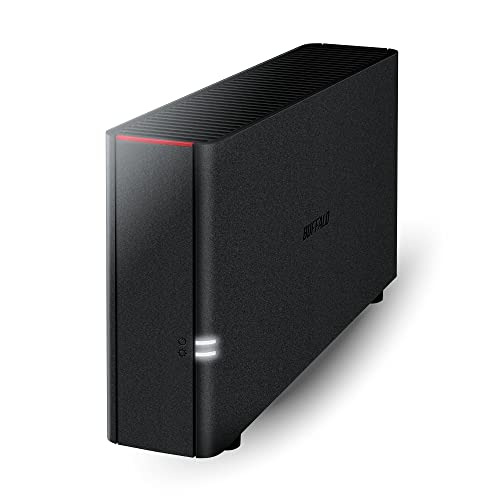
BUFFALO LinkStation 210 2TB 1-Bay NAS
Best for: Simple home storage and backup
- Drive Bays
- 1-Bay
- Included Storage
- 2TB
- Intended Use
- Home Users
- Dimensions
- 9.45 × 3.31 × 8.67 inches
- Weight
- 2.43 pounds
View on Amazon: BUFFALO LinkStation 210 2TB 1-Bay NAS Affiliate link
The BUFFALO LS210 is a single-bay NAS drive with 2TB of included storage. It connects to your router for centralized file sharing and backup. The closed system reduces third-party vulnerabilities, while SSL encryption secures transfers. It supports Windows and macOS 15 or earlier. This device suits home users who need a simple, subscription-free cloud for photos and videos without complex setup.
Pros
- 2TB HDD included in 1-bay chassis
- Closed system reduces third-party app vulnerabilities
- SSL encryption for secure file transfers
- Automated backup via NAS Navigator 2
Cons
- Single drive bay offers no RAID redundancy
- Limited to macOS 15 and earlier compatibility
- No support for macOS 26 (Sequoia)
Good fit if
- You need a simple, single-drive storage solution
- You want to avoid monthly subscription fees
- You use Windows or older macOS versions
Skip if
- You require RAID data redundancy
- You need macOS 26 (Sequoia) support
- You want expandable multi-bay capacity
Verdict: The BUFFALO LS210 2TB 1-Bay NAS is a secure, entry-level storage unit for home users who prioritize simplicity and data security over expandability. It fits users needing a single drive with straightforward backup features.
Specifications side by side
| Spec | QNAP TS-673-4G 8-Bay NAS | BUFFALO LinkStation 210 2TB 1-Bay NAS |
|---|---|---|
| Drive Bays | 6 Bay | 1-Bay |
| Network Connectivity | 4x GbE LAN | not stated |
| RAM Capacity | 4GB DDR4 | not stated |
| M.2 NVMe Slots | 2 slots | not stated |
| Included Storage | not stated | 2TB |
| Number of Bays | 8-Bay | not stated |
| Processor Cores | Quad-Core | not stated |
| Intended Use | not stated | Home Users |
| Dimensions | 11 × 10.4 × 7.41 inches | 9.45 × 3.31 × 8.67 inches |
| Weight | 12.3 pounds | 2.43 pounds |
| Size | 4GB RAM | 2TB (1x2TB) |
| Color | Black | Black |
| Model | TS-673-4G-US | LS210D0201 |
Frequently asked questions
Which NAS is better for home backup simplicity?
The BUFFALO LinkStation 210 is designed for simple home storage and backup. It targets home users who want a secure, entry-level unit. This device supports a single 2TB drive. You get straightforward backup features without complex configuration. It is ideal if you prioritize ease of use over expandability.
Can I run virtualization tasks on these NAS drives?
The QNAP TS-673-4G supports virtualization tasks due to its robust processing power. It features a quad-core processor and 4GB of RAM. This hardware allows it to manage large files and run containerized apps. The BUFFALO LinkStation 210 is not specified for such heavy workloads, focusing instead on basic file sharing.
What is the maximum storage capacity for these models?
The QNAP TS-673-4G offers eight drive bays for massive storage expansion. It supports six 2.5 or 3.5-inch drives plus two M.2 SSD slots. The BUFFALO LinkStation 210 provides only one bay with a 2TB pre-installed drive. You must choose based on whether you need single-drive simplicity or multi-drive scalability.
Do these NAS devices support media transcoding?
The QNAP TS-673-4G is suited for media transcoding thanks to its processing power. Its quad-core CPU handles intensive tasks like video conversion. The BUFFALO LinkStation 210 is positioned for simple home storage. It focuses on data security and straightforward backup rather than high-performance media processing or transcoding capabilities.
How many network ports do these units have?
The QNAP TS-673-4G includes four GbE ports for scalable networking. This allows for bond connections or separate network segments. The BUFFALO LinkStation 210 is an entry-level unit. It is designed for basic home networking. You should check the specific port count in the full specifications if you need multiple connections.
Which NAS is smaller and lighter for home use?
The BUFFALO LinkStation 210 is significantly smaller and lighter. It weighs 2.43 pounds and measures 9.45 inches in length. The QNAP TS-673-4G weighs 12.3 pounds and is much larger. The BUFFALO unit fits easily on a shelf, while the QNAP requires more space due to its eight-bay design.
Is RAID configuration flexible on both devices?
The QNAP TS-673-4G allows for flexible RAID configurations across its eight bays. You can mix drive sizes and types for optimal performance. The BUFFALO LinkStation 210 supports only one drive. It does not offer RAID options. You must choose QNAP if you need data redundancy or advanced storage management.