QNAP or MINISFORUM? NAS Devices Compared in 2026
As an Amazon Associate we earn from qualifying purchases. Links on this page are affiliate links.
This QNAP vs MINISFORUM NAS device comparison helps you choose the right hardware for your data needs. Both units offer extensive storage expansion and modern processors. The main difference lies in their physical design and network capabilities. QNAP provides an 8-bay tower with standard 1GbE ports and PCIe expansion. MINISFORUM offers a compact 5-bay desktop with built-in 10GbE and 5GbE ports. You must decide between maximum drive capacity or higher network speeds.
Key differences
| Aspect | QNAP TS-673-4G 8-Bay NAS | MINISFORUM N5 Pro 5-Bay Desktop NAS |
|---|---|---|
| Number of Bays | 8 Bays (6x 3.5"/2.5" + 2x M.2) | 5 Bays (3x M.2 + 2x U.2) |
| Network Connectivity | 4x 1GbE (optional 10GbE via PCIe) | 1x 10GbE + 1x 5GbE |
| Processor | AMD R-Series Quad-core 2.1GHz | AMD Ryzen AI 9 HX PRO 370 (12C/24T) |
| RAM Capacity | 4GB DDR4 | Not listed |
| Form Factor | Tower (10.4 x 7.41 x 11 inches) | Desktop (199 x 199 x 252 mm) |
Which one should you choose?
Choose QNAP TS-673-4G 8-Bay NAS if
- You need to store a large number of mechanical hard drives for centralized backup.
- You want the flexibility to add 10GbE or GPU cards via PCIe slots later.
- You prefer a traditional tower design that fits on a desk or in a rack.
Choose MINISFORUM N5 Pro 5-Bay Desktop NAS if
- You require faster network speeds with built-in 10GbE and 5GbE ports.
- You want a compact desktop form factor that saves space.
- You plan to use M.2 and U.2 SSDs for high-speed caching or storage.
Verdict: Choose the QNAP if your priority is raw storage capacity and expandability with standard 3.5-inch drives. Pick the MINISFORUM if you value high-speed networking and a compact footprint for SSD-based storage. Both devices offer robust processors to handle your data management tasks.
NAS Hardware Comparison
Number of Bays
The QNAP TS-673-4G offers eight drive bays, accommodating six 3.5-inch or 2.5-inch hard drives plus two M.2 SSD slots. This setup maximizes raw storage capacity for large media libraries or extensive backups. In contrast, the MINISFORUM N5 Pro features a five-bay configuration. It supports three M.2 NVMe slots and two U.2 interfaces, allowing for high-speed SSD storage. While the QNAP prioritizes traditional HDD capacity with more slots, the MINISFORUM focuses on a compact five-drive layout with faster NVMe options. You should choose based on whether you need maximum HDD slots or a mix of SSD speeds.
RAM Capacity
Memory is critical for handling multiple users and virtualization tasks. The QNAP TS-673-4G comes with 4GB of DDR4 RAM as standard, with an 8GB option available. This provides a solid baseline for running containerized apps and virtual machines. The MINISFORUM N5 Pro utilizes DDR5 RAM slots, which offer higher bandwidth and efficiency. Its modular design allows for quick upgrades to standard RAM modules, avoiding onboard limitations. DDR5 technology generally outperforms DDR4 in speed. If you plan to run heavy multitasking or virtualization workloads, the MINISFORUM’s modern DDR5 architecture provides a technical advantage for future-proofing your system.
Network Connectivity
Network speed determines how fast you can transfer files. The QNAP TS-673-4G includes four 1GbE LAN ports, providing reliable standard connectivity. It supports optional 10GbE expansion via PCIe cards, allowing you to upgrade later if needed. The MINISFORUM N5 Pro features built-in 10GbE and 5GbE ports, supporting link aggregation for up to 15Gbps throughput. This built-in high-speed connectivity eliminates the need for immediate PCIe expansion cards for faster networking. If you require high-speed transfers out of the box without adding extra hardware, the MINISFORUM offers superior integrated network capabilities for your data center.
Processor Performance
The processor handles data management and transcoding tasks. The QNAP TS-673-4G uses an AMD R-Series Quad-core 2.1GHz processor. This is a reliable choice for standard NAS operations and virtualization. The MINISFORUM N5 Pro features a powerful AMD Ryzen AI 9 HX PRO 370 with a 12-core and 24-thread design. It supports frequencies up to 5.1GHz and includes an NPU for AI-driven tasks like face recognition and image search. The MINISFORUM’s processor is significantly more powerful, offering superior performance for heavy workloads, AI analysis, and high-speed video transcoding compared to the QNAP’s quad-core unit.
Physical Form Factor
Space and design matter for your setup. The QNAP TS-673-4G is a tower-style NAS measuring 10.4 inches wide and 11 inches long. It weighs 12.3 pounds, providing a stable footprint for multiple drives. The MINISFORUM N5 Pro is a compact desktop unit measuring 199x199x252mm. It holds five drives in a smaller footprint, delivering 25% more storage density in less space. The MINISFORUM’s slide-out motherboard design simplifies maintenance and upgrades. If you have limited desk space or prefer a compact desktop form factor, the MINISFORUM is the better choice. The QNAP is better for traditional tower rack setups.
Which NAS fits your specific needs?
Users needing massive local storage capacity
The QNAP TS-673-4G provides eight drive bays, including slots for six 3.5-inch or 2.5-inch hard drives plus two M.2 SSDs. This configuration maximizes raw storage capacity for large media libraries or extensive backups, making it ideal if you prioritize sheer volume over processing speed.
Professionals requiring high-speed network connectivity
The MINISFORUM N5 Pro includes a 10GbE port and a 5GbE port, supporting link aggregation for up to 15Gbps speeds. This dual-port setup delivers significantly faster data transfer rates than the QNAP's standard 1GbE ports, benefiting users who frequently move large files across the network.
Creators seeking AI and media processing power
Powered by an AMD Ryzen AI 9 HX PRO 370 processor with 12 cores, this unit handles ultra-high-speed video decoding and AI-driven image analysis. Its PCIe 4.0 expansion slot allows for GPU upgrades, supporting real-time transcoding and advanced media management features not available on the QNAP.
The products compared

QNAP TS-673-4G 8-Bay NAS
Best for: Scalable storage with expansion flexibility
- Drive Bays
- 6 Bay
- Network Connectivity
- 4x GbE LAN
- RAM Capacity
- 4GB DDR4
- M.2 NVMe Slots
- 2 slots
- Number of Bays
- 8-Bay
- Processor Cores
- Quad-Core
View on Amazon: QNAP TS-673-4G 8-Bay NAS Affiliate link
The QNAP TS-673-4G is an 8-bay NAS drive featuring an AMD R-Series quad-core processor and 4GB of RAM. It includes four 1GbE ports and two PCIe slots for expansion. The unit supports dual M.2 SSDs for caching and optional NVIDIA graphics for 4K transcoding. This setup suits users needing scalable storage for virtualization and centralized backup.
Pros
- Eight drive bays for high capacity
- Four 1GbE LAN ports
- Dual PCIe Gen3 x4 slots for expansion
- Supports NVIDIA GT1030 for 4K transcoding
- Dual M.2 SSD slots for caching
Cons
- Includes only 4GB of RAM
- Base network speed limited to 1GbE
- Heavy and bulky chassis design
Good fit if
- You need extensive local storage capacity
- You require hardware acceleration for video
- You want to expand network speeds later
Skip if
- You need 10GbE connectivity out of the box
- You prefer a compact desktop footprint
- You require more than 4GB of RAM pre-installed
Verdict: QNAP TS-673-4G 8-Bay NAS provides robust expansion options for users building a scalable storage server. It fits those prioritizing hardware transcoding and modular growth over immediate high-speed networking.
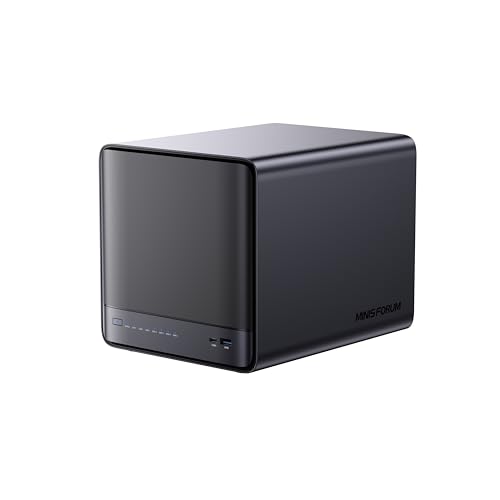
MINISFORUM N5 Pro 5-Bay Desktop NAS
Best for: high-performance desktop NAS needs
- Drive Bays
- 5-Bay
- Network Connectivity
- 1 x 10GbE, 1 x 5GbE
- Processor
- AMD Ryzen AI 9 HX PRO 370
- M.2 NVMe Slots
- 3 slots
- Included Storage
- 128GB SSD
- Form Factor
- Desktop
View on Amazon: MINISFORUM N5 Pro 5-Bay Desktop NAS Affiliate link
The MINISFORUM N5 Pro is a desktop NAS featuring an AMD Ryzen AI 9 HX PRO 370 processor and support for up to 188TB of storage. It includes one 10GbE and one 5GbE port for link aggregation. The unit comes with a built-in 128GB SSD for the MinisCloud OS, which occupies one M.2 slot. It supports RAID, AI photo analysis, and remote access for centralized data management.
Pros
- AMD Ryzen AI 9 HX PRO 370 processor with 12 cores
- Supports up to 188TB total storage capacity
- 10GbE and 5GbE ports with link aggregation
- Built-in 128GB SSD for MinisCloud OS
Cons
- Built-in 128GB SSD occupies one M.2 slot
- Mechanical hard drives sold separately
- Uses proprietary MinisCloud OS instead of standard NAS software
Good fit if
- You need high processing power for AI tasks
- You want flexible storage expansion up to 188TB
- You prefer desktop form factor with modular upgrades
Skip if
- You require standard NAS operating systems like QTS
- You want mechanical drives included with the unit
- You prefer compact 2-bay or 4-bay traditional NAS designs
Verdict: The MINISFORUM N5 Pro Desktop NAS suits users needing strong CPU performance and high capacity, though it differs from traditional NAS units by using a desktop architecture and proprietary software.
Specifications side by side
| Spec | QNAP TS-673-4G 8-Bay NAS | MINISFORUM N5 Pro 5-Bay Desktop NAS |
|---|---|---|
| Drive Bays | 6 Bay | 5-Bay |
| Network Connectivity | 4x GbE LAN | 1 x 10GbE, 1 x 5GbE |
| Processor | not stated | AMD Ryzen AI 9 HX PRO 370 |
| RAM Capacity | 4GB DDR4 | not stated |
| M.2 NVMe Slots | 2 slots | 3 slots |
| Included Storage | not stated | 128GB SSD |
| Form Factor | not stated | Desktop |
| Hardware Interface | not stated | M.2 NVMe, HDMI |
| Number of Bays | 8-Bay | not stated |
| Processor Cores | Quad-Core | not stated |
| Dimensions | 11 × 10.4 × 7.41 inches | not stated |
| Weight | 12.3 pounds | not stated |
| Size | 4GB RAM | N5 Pro(0+128G) |
| Color | Black | Black |
| Model | TS-673-4G-US | N5-Pro-P370(0+128) |
Frequently asked questions
Does the QNAP TS-673-4G support high-speed networking?
No, it uses standard 1GbE connectivity. This port speed is sufficient for most home offices and small businesses. However, it lacks the 5GbE or 10GbE options found in the MINISFORUM N5 Pro. You should verify your network switch capabilities before relying on this unit for heavy data transfers.
Is the MINISFORUM N5 Pro a traditional NAS device?
It differs from traditional units by using a desktop architecture. It features an AMD Ryzen processor and desktop-style hardware interfaces like HDMI. While it offers strong CPU performance, it relies on proprietary software rather than standard NAS operating systems. This design suits users who need general computing power alongside storage.
Which NAS has more drive bays?
The QNAP TS-673-4G has eight drive bays. It accommodates six 3.5-inch or 2.5-inch hard drives plus two M.2 SSD slots. This setup maximizes raw storage capacity for large media libraries. The MINISFORUM N5 Pro is a 5-bay desktop NAS, offering less total drive expansion for bulk storage needs.
What processor does the MINISFORUM N5 Pro use?
It uses an AMD Ryzen processor. This provides strong CPU performance for demanding tasks. The QNAP TS-673-4G, in contrast, uses a Quad-Core processor. The Ryzen chip in the MINISFORUM unit is better suited for hardware transcoding and intensive desktop workloads compared to the standard NAS-focused CPU in the QNAP model.
Can I expand the QNAP TS-673-4G later?
Yes, it provides robust expansion options for users building a scalable storage server. It includes slots for M.2 SSDs in addition to the main drive bays. This modular growth allows you to add speed and capacity over time. The unit is designed for those prioritizing hardware flexibility over immediate high-speed networking connections.
Is the MINISFORUM N5 Pro suitable for heavy media libraries?
It suits users needing strong CPU performance and high capacity. The AMD Ryzen processor handles intensive tasks well. However, it has fewer drive bays than the QNAP TS-673-4G. If your primary goal is massive local storage for many files, the QNAP unit with its eight bays offers more physical space for your drives.