Seagate IronWolf Pro 14TB NAS Review: Who It Fits and Who Should Skip It
As an Amazon Associate we earn from qualifying purchases. Links on this page are affiliate links.
This seagate ironwolf pro 14tb NAS review covers a drive built for heavy workloads. It offers 14 TB of storage and runs at 7,200 RPM. These two specs define its high-performance nature. The drive uses CMR technology for reliable data access. It is designed for 24/7 operation in multi-bay systems. You get 256 MB of cache to help manage data flow. The IronWolf Pro targets users who need consistent speed. It supports SATA 6 Gb/s interfaces for standard connectivity. This model aims to balance capacity with rotational speed for demanding environments.
What stands out
- 7,200 RPM rotational speed for fast data access
- 14 TB storage capacity for large media libraries
- 256 MB cache buffer to handle large file transfers
- CMR recording technology for reliable write performance
- 550TB/year workload rate limit for heavy usage
Who it fits
Good fit for
You should choose this drive if you run a busy NAS with many active users. The 7,200 RPM speed helps when multiple people access files at once. The 550TB/year workload rating suits those who write large amounts of data daily. Its CMR technology is ideal for RAID setups where consistency matters. If you need high capacity without sacrificing rotational speed, this 14 TB model fits your multi-bay enclosure well.
Who should skip it
You should skip this drive if you prioritize quiet operation. The 7,200 RPM speed generates more noise than slower 5,400 RPM drives. If you store cold data that you rarely access, the high speed offers little benefit. You might also look elsewhere if you need lower power consumption. This drive is built for performance, not silence or energy efficiency. Users with small, light workloads may find the speed unnecessary for their needs.
Verdict: This drive delivers high-speed performance for demanding NAS environments. It suits users who need capacity and rotational speed together.
Key specs explained for you
Storage Capacity 14 TB
This value tells you how much data fits on the drive. You get 14 terabytes for your files, videos, and backups. It suits users with large media libraries or extensive business archives. When shopping, compare this capacity against smaller 8 TB or 10 TB models to see if you need more space. It defines the total volume available for your NAS storage pool.
Rotational Speed 7,200 RPM
This number indicates how fast the internal platters spin each minute. Higher speeds like 7,200 RPM generally offer faster data access and transfer rates than 5,400 RPM drives. This benefits users who need quick retrieval for active projects or heavy database work. You should compare this against lower-speed drives if you prioritize quiet operation over raw performance.
Recording Technology CMR
CMR stands for Conventional Magnetic Recording. This technology writes data in parallel tracks, which ensures consistent performance during heavy write tasks. It is essential for RAID arrays where multiple drives work together. When comparing, avoid SMR drives for heavy NAS use. CMR prevents performance drops when you are writing large files simultaneously.
Workload Rate Limit Up to 550TB/year
This rating shows the maximum amount of data you can write to the drive annually. A 550 TB limit supports very heavy usage in enterprise or prosumer environments. It suits users who constantly update large datasets or run virtual machines. Compare this against standard 180 TB limits found in consumer drives to ensure your drive can handle your specific workload intensity.
Cache Size 256 MB
The cache is a small, fast memory buffer on the drive. A 256 MB size helps manage data flow between the platters and your computer. This reduces delays during large file transfers and improves overall system responsiveness. When shopping, compare this against drives with smaller 64 MB or 128 MB caches, as larger buffers often handle complex tasks more efficiently.
Physical Design And Build Details
According to the listing, this drive measures 5.79 inches in length, 4.01 inches in width, and 1.03 inches in height. It weighs 1.48 pounds. These dimensions match the standard 3.5-inch form factor used in most desktop NAS enclosures and server racks. You will need a bay that supports this specific size. The physical layout is simple, with no external buttons, displays, or indicator lights visible on the casing. The finish is utilitarian, designed to fit inside a chassis where aesthetics do not matter. This compact footprint allows you to pack more drives into a single unit without excessive bulk.
The internal construction relies on a 7,200 RPM spindle speed. This rotational speed contributes to the drive’s weight and generates more heat than slower models. The listing notes the inclusion of rotational vibration (RV) sensors. These sensors help stabilize the platters in multi-bay environments where multiple drives operate simultaneously. This feature is critical for maintaining performance and longevity when the drive is part of a larger RAID array. The 256 MB cache buffer sits on the circuit board, reducing latency for frequent small file reads. You should ensure your NAS case has adequate airflow to handle the heat generated by these high-speed components. The design prioritizes durability and consistent performance over quiet operation or visual appeal.
Setup And Everyday Use Guide
Installing this drive is straightforward for most NAS users. The 3.5-inch form factor and SATA 6 Gb/s interface ensure compatibility with standard enclosures. You simply mount the unit and connect the cable. The 7,200 RPM rotational speed and 256 MB cache support rapid data transfer. This configuration helps maintain consistent performance during heavy workloads. The drive is optimized for multi-bay environments through AgileArray technology. Dual-plane balancing and rotational vibration sensors help stabilize the platters. This reduces errors when the drive operates alongside others in a RAID array. Time-limited error recovery ensures the system remains responsive during read/write tasks. Daily use benefits from the high workload rate limit of up to 550 TB per year. This rating indicates the drive can handle significant data throughput without degradation. The CMR recording technology provides reliable access to your files. You can expect steady performance for backups and media streaming. IronWolf Health Management offers proactive monitoring. This feature provides recommendations to keep the system running smoothly. The drive also includes Rescue Data Recovery Services for three years. This adds a layer of security for your important data. The 2.5 million hour MTBF suggests strong long-term reliability. You can trust this drive for continuous 24/7 operation. It is built to withstand the demands of professional NAS environments. The specifications align with users who need consistent, high-speed access to large datasets. Setup requires no special tools beyond standard NAS hardware. The interface and dimensions fit seamlessly into existing systems.
Before You Buy This NAS Drive
Before you add this drive to your system, verify your NAS supports 3.5-inch form factors and SATA 6 Gb/s interfaces. The 7,200 RPM speed generates more heat and noise than lower-RPM alternatives, so ensure your enclosure has adequate airflow. You should also confirm your RAID controller handles rotational vibration sensors effectively, as this drive includes them for multi-bay stability. The 256 MB cache aids in handling large file transfers, but you must check that your motherboard’s SATA ports are not saturated. This drive fits best in heavy-duty environments where 550TB annual workload ratings are necessary. It sits above standard NAS drives in performance but requires more robust cooling. Compare it against 5,400 RPM models if quiet operation is a priority. Ensure your power supply can handle the spin-up current of multiple such drives in a single chassis.
Check before you buy
- Confirm your NAS supports 3.5-inch drives and SATA 6 Gb/s
- Verify your enclosure has sufficient airflow for 7,200 RPM heat
- Check RAID controller compatibility with rotational vibration sensors
- Ensure power supply handles multi-drive spin-up current
- Compare workload ratings against your annual data access needs
The product at a glance
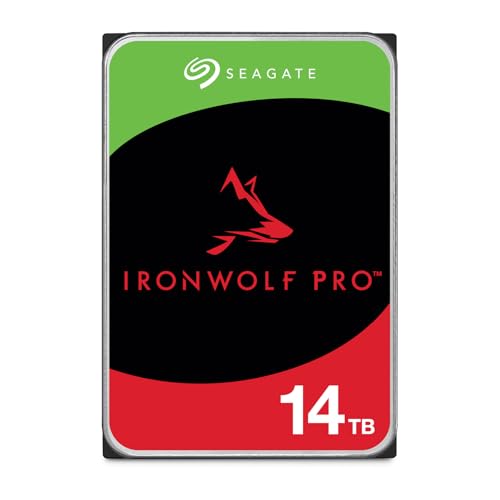
Seagate IronWolf Pro 14TB NAS HDD
Best for: multi-bay NAS systems requiring high workload ratings
- Storage Capacity
- 14 TB
- Form Factor
- 3.5 Inch
- Hardware Interface
- SATA 6 Gb/s
- Rotational Speed
- 7,200 RPM
- Cache Size
- 256 MB
- Recording Technology
- CMR
View on Amazon: Seagate IronWolf Pro 14TB NAS HDD Affiliate link
This Seagate IronWolf Pro is a 14TB enterprise-class hard drive designed for multi-bay NAS systems. It uses CMR recording and spins at 7,200 RPM for consistent performance. The drive includes a 256 MB cache and supports SATA 6 Gb/s interfaces. With a 550TB/year workload rating and RV sensors, it suits users needing high reliability and RAID optimization for heavy data access.
Pros
- CMR recording technology for consistent write speeds
- 7,200 RPM rotational speed for high performance
- 256 MB cache buffer for improved data handling
- Built-in rotational vibration sensors for RAID stability
Cons
- Heavier build at 1.48 pounds compared to standard drives
- Higher noise levels due to 7,200 RPM operation
- Requires active cooling in enclosed NAS enclosures
Good fit if
- You run a multi-bay NAS with rotational vibration issues
- You need high workload ratings for 24/7 enterprise use
- You prioritize write consistency over quiet operation
Skip if
- You need a silent drive for a home office
- You only have a single-bay NAS enclosure
- You prefer lower power consumption drives
Verdict: Seagate IronWolf Pro 14TB NAS Drive is a high-performance storage solution for users running dense, multi-bay NAS systems who require robust RAID stability and high workload ratings.
Specifications side by side
| Spec | Seagate IronWolf Pro 14TB NAS HDD |
|---|---|
| Storage Capacity | 14 TB |
| Form Factor | 3.5 Inch |
| Hardware Interface | SATA 6 Gb/s |
| Rotational Speed | 7,200 RPM |
| Cache Size | 256 MB |
| Recording Technology | CMR |
| Workload Rate Limit | Up to 550TB/year |
| Dimensions | 5.79 × 4.01 × 1.03 inches |
| Weight | 1.48 pounds |
| Size | 14 |
| Color | OLD |
| Model | ST14000NT001 |
Frequently asked questions
Is the Seagate IronWolf Pro 14TB suitable for RAID setups?
Yes, it is built for multi-bay NAS systems requiring high workload ratings. The drive features CMR recording technology, which ensures stable data access and robust RAID stability. This makes it a reliable choice for users running dense storage arrays who need consistent performance under heavy load.
What interface does this NAS drive use?
It uses a SATA hardware interface. This standard connection ensures compatibility with most desktop NAS enclosures and server boards. You simply connect the SATA cable to establish communication between the drive and your system, allowing for straightforward integration into existing storage infrastructure without needing special adapters.
Does this drive use SMR or CMR technology?
This drive utilizes CMR recording technology. Unlike SMR, CMR offers more reliable data access and better performance during heavy write operations. This specification is critical for RAID environments, as it prevents potential slowdowns and ensures consistent throughput when multiple drives are writing data simultaneously.
How much cache memory does the IronWolf Pro have?
It includes 256 MB of cache memory. This buffer helps manage data flow between the drive and your system, improving overall efficiency. A larger cache size supports smoother performance during intensive tasks, making it well-suited for users who require high workload ratings and robust stability in their NAS setups.
What are the physical dimensions of this 14TB drive?
The drive measures 5.79 inches in length, 4.01 inches in width, and 1.03 inches in height. It weighs 1.48 pounds. These dimensions correspond to the standard 3.5-inch form factor, ensuring it fits into most standard desktop NAS enclosures and server bays designed for larger hard drives.
Who is the best target user for this specific model?
It is best for users running dense, multi-bay NAS systems. The drive is designed for those requiring high workload ratings and robust RAID stability. If you manage extensive business archives or large media libraries, this high-performance solution provides the reliability and capacity needed for demanding, continuous operation environments.