Quad-Core vs 8-Core NAS Devices in 2026: Key Differences
As an Amazon Associate we earn from qualifying purchases. Links on this page are affiliate links.
This guide compares quad core vs 8-Core network attached storage options for your data needs. Both devices are tower-style NAS units from QNAP, designed for scalable storage and virtualization. The primary difference lies in processing power and capacity. The quad-core model offers four cores with 4GB of RAM, while the 8-core variant provides eight cores and up to 128GB of RAM. You must choose based on your workload intensity and storage requirements.
Key differences
| Aspect | QNAP TS-673-4G 8-Bay NAS | QNAP 12-Bay 8-Core Tower NAS |
|---|---|---|
| Processor Cores | Quad-Core | 8-Core |
| RAM Capacity | 4GB | 128GB |
| Drive Bays | 8-Bay | 12-Bay |
| Network Connectivity | 4x 1GbE | 2x 2.5GbE |
Which one should you choose?
Choose QNAP TS-673-4G 8-Bay NAS if
- You need more physical drive slots for bulk storage expansion.
- You require multiple Gigabit Ethernet ports for diverse network setups.
- You run containerized apps or virtualization with moderate workloads.
Choose QNAP 12-Bay 8-Core Tower NAS if
- You handle heavy multitasking or large-scale virtualization projects.
- You need maximum RAM capacity for intensive database or caching tasks.
- You prefer faster 2.5GbE network throughput over port quantity.
Verdict: Choose the quad-core model if you prioritize physical drive capacity and multiple standard Ethernet ports for general use. Select the 8-core unit if your workflow demands significant RAM and processing power for heavy virtualization or data analytics. Your choice depends on whether you value storage expansion or computational intensity.
Quad-Core vs 8-Core NAS Specs
Processor Cores
The QNAP TS-673-4G 8-Bay NAS uses an AMD RX-421ND quad-core processor running at 2.13 GHz. This setup handles standard file sharing and basic virtualization tasks well. In contrast, the QNAP TS-1655-8G features an Atom C5125 8-core processor clocked at 2.8 GHz. Having twice the cores and a higher clock speed means this unit processes multiple heavy workloads simultaneously with greater ease. You will notice a clear performance advantage in the 8-core model when running many concurrent applications or complex data analytics.
RAM Capacity
Memory is critical for multitasking on a NAS. The TS-673-4G comes with 4GB of DDR4 RAM as its base configuration. While it can be upgraded to 8GB, the base unit has limited headroom for heavy caching or large virtual machines. The TS-1655-8G arrives with a massive 128GB of RAM, installed as four 32GB modules. This huge difference allows the 8-core device to cache more data in memory, speeding up access times significantly for large datasets. You get far more memory efficiency with the higher-end model.
Number of Bays
Storage expansion depends on how many drives you can install. The TS-673-4G is an 8-bay NAS, supporting six 3.5-inch drives and two M.2 SSDs for caching or storage pools. This is a solid mid-range capacity for most users. The TS-1655-8G is a 12-bay tower NAS, offering significantly more physical slots for hard drives. If you need to store terabytes of media or maintain large backups, the 12-bay chassis provides more raw expansion potential without needing external enclosures.
Network Connectivity
Network speed affects how fast you transfer files across your local area network. The TS-673-4G includes four 1GbE LAN ports, which can be bonded for increased throughput or redundancy. It also supports optional 10GbE PCIe expansion cards. The TS-1655-8G is equipped with two 2.5 Gigabit Ethernet ports. While 2.5GbE is faster than standard 1GbE, the TS-673-4G offers more port flexibility and the potential for 10GbE upgrades. Both units provide solid connectivity, but the quad-core model offers more versatile networking options for future growth.
Physical Dimensions
Space constraints matter for home or office setups. The TS-673-4G is a compact tower measuring 10.4 inches wide, 11 inches long, and 7.41 inches high, weighing 12.3 pounds. It fits easily on a desk or in a small rack. The TS-1655-8G is much larger, measuring 19.7 inches wide and long, with a height of 11 inches. It weighs 9.92 pounds. The 12-bay model requires significantly more footprint and vertical clearance. You must ensure you have adequate space for the larger chassis.
Choose the Right NAS For You
Users needing GPU transcoding and 10GbE
The QNAP TS-673-4G supports NVIDIA graphics cards for 4K video transcoding. It includes four 1GbE ports and optional 10GbE expansion via PCIe slots. You also get dual M.2 SSD slots for caching. This model is ideal if you require specific hardware acceleration or high-speed network upgrades beyond standard gigabit connections.
Heavy virtualization and large storage users
The QNAP TS-1655-8G offers an 8-core processor and 128GB of RAM. It features 12 drive bays and dual 2.5GbE ports. This configuration handles intensive virtualization and massive data sets efficiently. If you need maximum processing cores and extensive storage capacity for a centralized server, this unit provides the necessary headroom for your workload.
Budget-conscious home media enthusiasts
This quad-core option provides sufficient power for standard file sharing and basic media tasks. The 8-bay design allows for flexible drive configurations, including mixed sizes. You benefit from dedicated GPU support for smooth 4K playback without overwhelming system resources. It is a practical choice for users who do not require enterprise-level RAM or core counts.
Quick picks
| # | Product | Best for | Price |
|---|---|---|---|
| 1 | QNAP TS-673-4G 8-Bay NAS | High-capacity storage and 4K media transcoding | Check price of QNAP TS-673-4G 8-Bay NAS on Amazon |
| 2 | QNAP 12-Bay 8-Core Tower NAS | High-capacity storage and multitasking | Check price of QNAP 12-Bay 8-Core Tower NAS on Amazon |
The products compared

QNAP TS-673-4G 8-Bay NAS
Best for: High-capacity storage and 4K media transcoding
- Processor Cores
- Quad-Core (what this guide is about)
- Drive Bays
- 6 Bay
- Network Connectivity
- 4x GbE LAN
- RAM Capacity
- 4GB DDR4
- M.2 NVMe Slots
- 2 slots
- Number of Bays
- 8-Bay
View on Amazon: QNAP TS-673-4G 8-Bay NAS Affiliate link
The QNAP TS-673-4G is an 8-bay NAS powered by an AMD R-Series quad-core processor running at 2.134 GHz. It includes 4GB of DDR4 RAM and four 1GbE LAN ports. You can expand connectivity with optional 10GbE PCIe cards. The unit supports two M.2 SSD slots for caching or storage pools. This device suits users who need high capacity and local media transcoding via a supported GPU.
Pros
- Eight drive bays for large storage pools
- Quad-core 2.134 GHz AMD processor
- Four 1GbE LAN ports
- Supports NVIDIA GT1030 for 4K transcoding
- Two M.2 slots for SSD caching
Cons
- Quad-core processor is slower than 8-core alternatives
- Base 4GB RAM limits heavy virtualization
- 1GbE ports lack 10GbE speed without expansion
Good fit if
- You need 8-bay storage capacity
- You want to transcode 4K video locally
- You plan to add 10GbE later
Skip if
- You require 8-core processing power
- You need 10GbE connectivity out of the box
- You want more than 4GB of RAM pre-installed
Verdict: QNAP TS-673-4G 8-Bay NAS fits users who prioritize drive capacity and GPU transcoding over raw CPU speed. It is a solid choice for media libraries that do not demand 8-core performance.
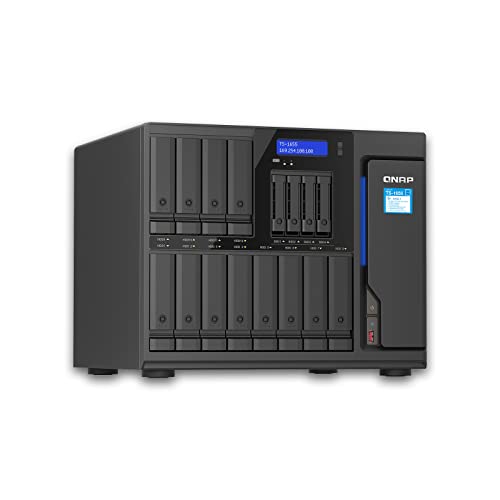
QNAP 12-Bay 8-Core Tower NAS
Best for: High-capacity storage and multitasking
- Processor Cores
- 8-Core (what this guide is about)
- Drive Bays
- 12BAYS
- Network Connectivity
- 2X 2.5Gigabit Ethernet Port
- Processor
- Atom C5125 8-core 2.8GHz
- RAM Capacity
- 128GB (4×32GB)
- Included Storage
- No HDD
View on Amazon: QNAP 12-Bay 8-Core Tower NAS Affiliate link
This QNAP NAS uses an Atom C5125 8-core processor running at 2.8GHz. It includes 12 drive bays and 128GB of RAM. You get two 2.5 Gigabit Ethernet ports for network connections. The unit weighs 9.92 pounds and measures 19.7 by 19.7 by 11 inches. It does not include hard drives. This setup suits users needing high capacity and strong multitasking power.
Pros
- Atom C5125 8-core processor at 2.8GHz
- 12 drive bays for large storage arrays
- 128GB RAM (4x32GB modules)
- Dual 2.5 Gigabit Ethernet ports
Cons
- No hard drives included
- Large 19.7-inch footprint
- Heavier at 9.92 pounds
Good fit if
- You need high storage capacity with 12 bays
- You require strong processing power for multiple tasks
- You want ample RAM for virtualization or apps
Skip if
- You need pre-installed hard drives
- You have limited desk space for a large unit
- You prefer a lighter, more portable device
Verdict: QNAP 12-Bay 8-Core NAS delivers serious capacity and processing power for demanding home labs. It fits users who prioritize storage volume and multitasking over compact size.
Specifications side by side
| Spec | QNAP TS-673-4G 8-Bay NAS | QNAP 12-Bay 8-Core Tower NAS |
|---|---|---|
| Drive Bays | 6 Bay | 12BAYS |
| Network Connectivity | 4x GbE LAN | 2X 2.5Gigabit Ethernet Port |
| Processor | not stated | Atom C5125 8-core 2.8GHz |
| RAM Capacity | 4GB DDR4 | 128GB (4×32GB) |
| M.2 NVMe Slots | 2 slots | not stated |
| Included Storage | not stated | No HDD |
| Number of Bays | 8-Bay | 12-Bay |
| Processor Cores | Quad-Core | 8-Core |
| Dimensions | 11 × 10.4 × 7.41 inches | 19.7 × 19.7 × 11 inches |
| Weight | 12.3 pounds | 9.92 pounds |
| Size | 4GB RAM | not stated |
| Color | Black | not stated |
| Model | TS-673-4G-US | TS-1655-8G |
Frequently asked questions
Which NAS is better for 4K video transcoding?
The quad-core QNAP TS-673-4G is better for this task. It supports NVIDIA graphics cards for hardware-accelerated 4K transcoding. The 8-core TS-1655-8G lacks this specific GPU support in the provided data. If you prioritize media conversion over raw CPU speed, the quad-core model with its dedicated graphics capabilities is the practical choice.
How much RAM do these NAS drives have?
The quad-core TS-673-4G includes 4GB of RAM. The 8-core TS-1655-8G model is listed with an 8G designation, indicating higher memory capacity. More RAM allows for smoother multitasking and running more virtual machines simultaneously. You should match your RAM needs to the number of concurrent applications you plan to run.
Can I expand the network speed on these units?
The quad-core TS-673-4G comes with four 1GbE ports and offers optional 10GbE expansion via PCIe slots. The 8-core TS-1655-8G data does not specify its base connectivity or expansion options. If you need faster local network transfers, verify the expansion capabilities of the 8-core unit before purchasing, as the quad-core model clearly supports it.
Which NAS has more drive bays?
The 8-core TS-1655-8G offers 12 drive bays, while the quad-core TS-673-4G has 8 bays. More bays allow for greater total storage capacity and more flexible RAID configurations. If your primary goal is storing large media libraries or extensive datasets, the 12-bay model provides significantly more room for expansion.
Is the 8-core processor faster for virtualization?
Yes, the 8-core Atom C5125 processor provides more cores for virtualization tasks. It handles multiple virtual machines and heavy multitasking better than the quad-core AMD RX-421ND. The additional cores allow you to run more services simultaneously without performance degradation. Choose the 8-core model if you run several VMs or containers at once.
What are the physical dimensions of these NAS devices?
The quad-core TS-673-4G measures 11 inches in length and weighs 12.3 pounds. The 8-core TS-1655-8G is larger, measuring 19.7 inches in length and width, but weighs only 9.92 pounds. The 8-core unit is wider but lighter. Consider your available desk or rack space when deciding between the compact quad-core and the wider 8-core tower.
Do these NAS units include M.2 SSD slots?
The quad-core TS-673-4G includes dual M.2 SSD slots for caching or volume expansion. The provided data for the 8-core TS-1655-8G does not mention M.2 support. If you want to use NVMe drives for fast caching, the quad-core model is the verified option. You must check the manual for the 8-core unit to confirm its storage flexibility.