15 Best 4-Bay Hard Drive Enclosures, Compared
As an Amazon Associate we earn from qualifying purchases. Links on this page are affiliate links.
Finding the best 4-Bay hard drive enclosures requires matching form factor, data connections, and hardware capabilities to your workload. We evaluated 15 models based strictly on the specifications published on their product listings.
The Synology 4-Bay Rackmount Expansion Unit takes the top position because its compact 12-inch rack depth delivers four-bay expansion inside shallow server cabinets. This guide helps you decide whether a direct-attached USB model, an expandable desktop unit, or a multi-gigabit rackmount enclosure fits your data storage setup.
Quick picks
The best fit for you
- You need shallow rackmount expansion for your Synology system Synology 4-Bay Rackmount Expansion Unit Its 12-inch rack depth and four drive bays enable direct online storage expansion.
- You need direct-attached storage featuring integrated hardware RAID QNAP 4-Bay USB-C Hardware RAID Enclosure This four-bay unit provides dedicated hardware RAID controls and a USB-C connection.
- You need maximum system memory for intensive network virtualization TERRAMASTER 4-Bay 16GB DDR5 NAS It comes equipped with 16GB of DDR5 RAM and dual 5GbE networking ports.
- You need multiple M.2 NVMe slots for SSD caching Asustor 4-Bay Quad-Core NVMe NAS It includes four dedicated NVMe slots alongside dual 2.5GbE network connections.
Our 15 picks

Synology 4-Bay Rackmount Expansion Unit
Best for: shallow-depth rackmount Synology storage expansion
- Number of Bays
- 4-Bay (what this guide is about)
- Dimensions
- 17 × 11.4 × 1.73 inches
- Weight
- 9.44 pounds
This Synology 4-bay expansion unit adds storage bays to your existing setup with plug-and-play setup. It features a shallow 12-inch depth that fits two-post and wall-mount racks, measuring 1.73 inches high and weighing 9.44 pounds. Managed directly through Synology DiskStation Manager, it supports online volume expansion and deep sleep mode. It suits you if you need compact rackmount drive expansion.
Pros
- Compact 12-inch depth fits 2-post and wall mount racks
- Supports online volume expansion via Synology DiskStation Manager (DSM)
- Energy-saving deep sleep mode
- Plug-and-play design for direct storage upgrades
Cons
- Requires a compatible Synology DSM host to operate
- Ships diskless with no storage drives included
Good fit if
- You run a Synology host managed by DiskStation Manager (DSM).
- You need 4 bays in a 12-inch shallow rack or wall-mount enclosure.
- You want online volume expansion without taking storage offline.
Skip if
- You need an independent, standalone NAS device.
- You want an enclosure that arrives with hard drives pre-installed.
Verdict: Synology 4-Bay Rackmount Expansion Unit delivers plug-and-play storage growth with a compact 12-inch rack depth. It integrates directly with DiskStation Manager for simple online volume expansion.
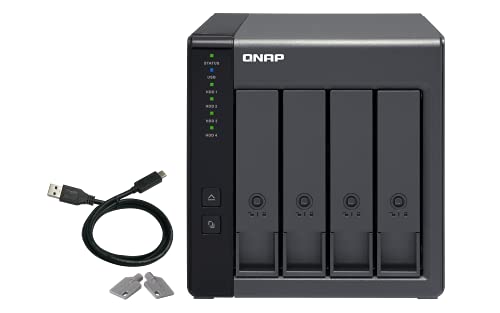
QNAP 4-Bay USB-C Hardware RAID Enclosure
Best for: direct-attached hardware RAID storage and backups
- Number of Bays
- 4-Bay (what this guide is about)
- Hardware Interface
- USB Type-C
- Dimensions
- 8.62 × 6.31 × 6.63 inches
- Weight
- 4.08 pounds
The QNAP 4-Bay USB-C Hardware RAID Enclosure is a direct-attached storage unit for 3.5-inch SATA hard drives. It connects to Windows, macOS, or Linux systems using a USB Type-C interface, or attaches directly to a compatible QNAP NAS for backup. Onboard hardware RAID handles RAID 0, 1, 5, JBOD, or individual drive modes without taxing host resources. Four lockable bays secure drives, fitting direct local storage setups.
Pros
- Hardware RAID supports RAID 0, 1, 5, JBOD, and individual disk modes
- USB Type-C connection includes a Type-C to Type-A cable
- Four lockable 3.5-inch drive bays for physical security
- Compatible with Windows, macOS, Linux, and select QNAP NAS devices
Cons
- Internal drive bays support SATA 3Gb/s speeds rather than SATA 6Gb/s
- Cannot run standalone NAS applications directly on the enclosure
- Storage pool cannot be merged into an existing connected NAS volume
Good fit if
- You want direct-attached USB storage with hardware-managed RAID modes.
- You need external expansion or dedicated backup for a compatible QNAP NAS.
- You require physically lockable drive bays for your 3.5-inch drives.
Skip if
- You need SATA 6Gb/s drive interface speeds.
- You plan to run network apps directly from the enclosure hardware.
- You use an excluded NAS model such as the TS-131 or TS-431.
Verdict: QNAP 4-Bay USB-C Hardware RAID Enclosure provides practical direct-attached capacity with integrated RAID controls and physical drive locks. It works reliably for local storage expansion across multiple desktop operating systems.

Synology 4-Bay Intel Quad-Core NAS
Best for: expandable storage with dedicated NVMe SSD caching
- Number of Bays
- 4-Bay (what this guide is about)
- Processor Cores
- quad-core
- RAM Capacity
- 4 GB DDR4
- Dimensions
- 8.78 × 7.83 × 6.54 inches
- Weight
- 4.94 pounds
This Synology unit is a 4-bay network attached storage enclosure designed for shared backups and data management. It runs on an Intel quad-core processor with 4 GB of DDR4 memory, expandable to 8 GB. You also get two dedicated M.2 2280 NVMe SSD cache slots that do not occupy the main drive bays. It suits you if you need reliable local storage capable of scaling up to nine drives with an expansion unit.
Pros
- Two dedicated M.2 2280 NVMe SSD slots for caching without using drive bays
- Scalable up to nine drives using a Synology DX517 unit
- Intel quad-core processor with AES-NI hardware encryption engine
- Over 225 MB/s sequential read and write throughput
Cons
- Memory expands only up to 8 GB
- Includes only two camera licenses by default
- Drives are not included in the enclosure
Good fit if
- You need dedicated NVMe SSD cache slots that leave all four storage bays free.
- You plan to expand your setup to nine drives using a DX517 expansion unit.
- You want hardware encryption with an Intel quad-core processor.
Skip if
- You need more than 8 GB of DDR4 memory.
- You require more than two surveillance camera licenses out of the box.
Verdict: Synology DiskStation 4-Bay Quad-Core NAS provides four-bay network storage with dedicated NVMe caching slots and expansion headroom up to nine drives. Its quad-core processor and expandable memory make it a capable option for centralized file handling.

Synology 4-Bay Compact Rackmount NAS
Best for: shallow rackmount setups needing upgradeable networking
- Number of Bays
- 4-Bay (what this guide is about)
- Network Connectivity
- Dual 1GbE
- Form Factor
- Rackmount
- Dimensions
- 21 × 15.8 × 5.45 inches
The Synology RackStation 4-Bay Rackmount NAS gives you a four-bay rackmount storage system built for shallow spaces, measuring 327.5 mm deep with server handles installed. It delivers sequential throughput over 601 MB/s read and 516 MB/s write. Dual 1GbE network ports provide failover and load balancing support, while plug-and-play upgrade modules allow adding 10GbE RJ-45 connectivity. It suits you if you need compact rack storage.
Pros
- Over 601 MB/s read and 516 MB/s write sequential throughput
- Compact 327.5 mm chassis depth with server handles installed
- Dual 1GbE ports supporting network failover and load balancing
- Supports plug-and-play upgrade modules for 10GbE RJ-45 ports
Cons
- Ships diskless without hard drives included
- Requires optional upgrade module for 10GbE speeds
- Rackmount form factor requires compatible server cabinet space
Good fit if
- You want a 4-bay rackmount NAS designed for shallow-depth server racks.
- You need dual 1GbE ports that support failover and load balancing.
- You plan to add 10GbE RJ-45 connectivity later via an upgrade module.
Skip if
- You want a desktop tower enclosure instead of a rackmount chassis.
- You need pre-installed storage drives included out of the box.
Verdict: Synology RackStation 4-Bay Rackmount NAS provides four drive bays and shallow-depth rack mounting with sequential speeds reaching over 601 MB/s read. It is a capable choice if you need dual 1GbE networking with an optional 10GbE upgrade path.

QNAP 4-Bay 2.5GbE NAS Enclosure
Best for: multi-gigabit home backups and centralized storage
- Number of Bays
- 4-Bay (what this guide is about)
- Processor
- Cortex-A55 ARM
- Processor Cores
- 4-core
- RAM Capacity
- 4GB
- Network Connectivity
- 1x 2.5Gigabit Ethernet Port
- Dimensions
- 2.48 × 3.39 × 2.62 inches
This QNAP unit is a 4-bay tower NAS designed for centralized local network storage. It runs on a 2.0 GHz quad-core Cortex-A55 ARM processor paired with 4 GB of built-in memory. A dedicated 2.5 Gigabit Ethernet port provides multi-gigabit transfer rates for your local network without requiring dual-cable aggregation. It accommodates up to 80 TB of total capacity across its four drive bays, making it suitable if you need multi-gigabit network storage.
Pros
- 2.5 Gigabit Ethernet port for high-speed network connectivity
- Quad-core 2.0 GHz Cortex-A55 processor
- Four drive bays supporting up to 80 TB total storage
- 4 GB built-in system memory
Cons
- Hard drives are not included in the enclosure
- Only one network port provided
- Built-in memory limits future expansion
Good fit if
- You have a 2.5GbE local network switch or router.
- You need up to 80 TB of storage across four bays.
- You want an energy-efficient quad-core ARM processor with 4 GB RAM.
Skip if
- You need dual network ports for failover or link aggregation.
- You require pre-installed hard drives out of the box.
Verdict: QNAP 4-Bay 2.5GbE NAS delivers solid multi-gigabit networking and 80 TB capacity in a compact quad-core tower. It provides a balanced four-drive foundation for local backups and centralized data access.

Synology 4-Bay NAS with 2GB RAM
Best for: centralized 4-bay backups and video surveillance
- Number of Bays
- 4-Bay (what this guide is about)
- RAM Capacity
- 2GB RAM
- Dimensions
- 9 × 6.6 × 7.24 inches
- Weight
- 4.87 pounds
This Synology 4-Bay Diskless NAS gives you a four-bay desktop storage hub designed for local file hosting, backups, and media handling. It features 2GB of DDR4 memory within a chassis measuring 6.6 by 7.24 by 9 inches and weighing 4.87 pounds. You can configure snapshots for ransomware defense and connect up to 30 IP cameras. It suits you if you need centralized 4-bay backup and surveillance without preinstalled drives.
Pros
- Four drive bays for expandable storage capacity
- Equipped with 2GB DDR4 memory
- Supports up to 30 IP cameras for video surveillance
- Backed by a 2-year hardware warranty
Cons
- Camera licenses must be purchased separately
- Diskless chassis includes no preinstalled hard drives
Good fit if
- You need a 4-bay private cloud for file sharing and snapshots.
- You plan to monitor up to 30 IP surveillance cameras.
- You want to supply your own drives in a diskless enclosure.
Skip if
- You require preinstalled hard drives ready out of the box.
- You need surveillance camera licenses included with the unit.
Verdict: Synology 4-Bay Diskless NAS provides four bays and 2GB DDR4 memory for secure local data storage and automated snapshots. It functions as an organized private file server and multi-camera surveillance hub.

Asustor 4-Bay Quad-Core NVMe NAS
Best for: content creators needing NVMe caching and 2.5GbE
- Number of Bays
- 4-Bay (what this guide is about)
- Processor
- Intel Celeron N5105
- Processor Cores
- Quad-Core
- RAM Capacity
- 4GB DDR4-2933
- Network Connectivity
- Two 2.5 Gigabit Ethernet ports
- M.2 NVMe Slots
- 4 x M.2
The Asustor 4-Bay Quad M.2 NAS is a 4-bay network storage enclosure powered by a quad-core Intel Celeron N5105 processor and 4GB of DDR4 memory. It equips you with four dedicated M.2 NVMe SSD slots alongside two 2.5 Gigabit Ethernet ports and three 10 Gbit/s USB 3.2 Gen 2 interfaces. This configuration provides fast flash storage options and high-speed data transfer suited for creative media production and large file workflows.
Pros
- Four M.2 slots for NVMe SSDs
- Dual 2.5 Gigabit Ethernet ports
- Three 10 Gbit/s USB 3.2 Gen 2 ports
- Quad-core Intel Celeron N5105 CPU
Cons
- Ships with 4GB baseline memory
- Lacks native 10GbE network ports
Good fit if
- You want up to four M.2 NVMe SSDs alongside four hard drives.
- You use 2.5GbE networking or 10 Gbit/s USB peripherals.
Skip if
- You need 10 Gigabit Ethernet networking out of the box.
- You require more than 4GB installed memory from factory.
Verdict: Asustor 4-Bay Quad M.2 NAS provides four NVMe slots and dual 2.5GbE connections for rapid local data transfer. It suits content workflows that balance mechanical drive capacity with solid-state caching.

TerraMaster 4-Bay NAS with 32GB RAM
Best for: High-performance compute and caching
- Number of Bays
- 4-Bay (what this guide is about)
- Processor
- Core i3-N305
- Processor Cores
- 8-Core
- RAM Capacity
- 32GB DDR5
- Network Connectivity
- Dual 2.5GbE
- M.2 NVMe Slots
- 2x M.2 NVMe
The TERRAMASTER F4-424 Pro is a 4-bay NAS drive enclosure built for high-performance computing. It features an 8-core Core i3-N305 processor and a substantial 32GB of DDR5 memory. You get dual 2.5GbE ports and dual M.2 NVMe slots for caching. This setup handles heavy workloads and fast file retrieval. It suits users who need maximum processing power and memory capacity for their storage needs.
Pros
- 32GB DDR5 RAM capacity
- 8-core Core i3-N305 CPU
- Dual 2.5GbE network ports
- Dual M.2 NVMe slots
Cons
- RAM is non-upgradable
- Uses USB 3.2 ports instead of Type-C
- Larger physical footprint than compact units
Good fit if
- You need high RAM for virtualization
- You run heavy database workloads
- You want fast application response times
Skip if
- You require upgradable RAM
- You prefer USB Type-C connectivity
- You need a compact desktop footprint
Verdict: TERRAMASTER F4-424 Pro 4-Bay NAS delivers exceptional processing power and memory for demanding tasks. It is the right choice for users who prioritize raw compute speed and data caching over expandability or compact design.

TerraMaster 4-Bay Multimedia NAS
Best for: home multimedia streaming and personal backups
- Number of Bays
- 4-Bay (what this guide is about)
- Processor
- ARM v8
- Processor Cores
- Quad-Core
- RAM Capacity
- 2GB
- Dimensions
- 7.28 × 8.66 × 7.09 inches
- Weight
- 4.6 pounds
The TerraMaster 4-Bay Quad-Core NAS is a diskless network storage enclosure designed for home backups and media serving. It features an ARM v8 quad-core 1.7GHz processor and 2GB of system memory running TOS 7. You can install up to four 3.5-inch or 2.5-inch SATA drives, reaching up to 88TB total storage. It suits you if you need centralized file sharing across multiple network protocols.
Pros
- Supports up to 88TB total storage capacity across four drive bays
- Hardware 4K video decoding with DLNA and UPnP streaming support
- Compatible with 3.5-inch SATA HDDs, 2.5-inch SATA HDDs, and 2.5-inch SATA SSDs
- Supports broad protocol selection including SMB, NFS, AFP, WebDAV, and iSCSI
Cons
- System memory is fixed at 2GB and cannot be upgraded
- Arrives diskless with no pre-installed hard drives
Good fit if
- You need a dedicated 4-bay enclosure for home media streaming via DLNA.
- You want up to 88TB of raw storage using standard SATA hard drives or SSDs.
- You require multi-platform file sharing across SMB, NFS, and WebDAV protocols.
Skip if
- You need more than 2GB of RAM or plan to upgrade system memory later.
- You want storage drives included out of the box.
Verdict: TerraMaster 4-Bay Quad-Core NAS delivers ample four-bay storage capacity and 4K media handling for home networks. Its non-upgradeable 2GB RAM keeps it focused strictly on light media streaming and standard file backups.

Asustor Lockerstor Gen3 4-Bay NAS
Best for: video editing and Docker container workloads
- Number of Bays
- 4-Bay (what this guide is about)
- Dimensions
- 7.28 × 6.69 × 9.06 inches
- Weight
- 7.05 pounds
The Asustor Lockerstor Gen3 is a 4-bay desktop NAS built for virtualization, Docker containers, and video editing workflows. It measures 9.06 inches high, 6.69 inches wide, and 7.28 inches deep, with a total weight of 7.05 pounds. You get a four-drive capacity in a compact black chassis designed for desktop environments. It suits you if you need localized storage for enterprise backup and containerized tasks.
Pros
- Four drive bays for multi-disk storage setups
- Supports virtualization, Docker containers, and AI workloads
- Compact desktop dimensions of 6.69 by 7.28 by 9.06 inches
- Solid 7.05-pound chassis in a black finish
Cons
- Processor and memory specifications not detailed in the listing
- Network port types and transfer speeds omitted from specifications
Good fit if
- You need a 4-bay desktop enclosure for virtualization or Docker containers.
- You want a compact black tower measuring under 10 inches tall.
Skip if
- You need a larger capacity chassis such as a 6-bay or 10-bay model.
- You require a rackmount form factor for a server cabinet.
Verdict: Asustor Lockerstor Gen3 4-Bay NAS provides four drive bays in a compact desktop enclosure designed for Docker, AI tasks, and video editing. Its 7.05-pound footprint makes it a solid option for desktop workstation setups.

Synology 4-Bay AMD Ryzen NAS
Best for: expandable AMD Ryzen network storage
- Number of Bays
- 4-Bay (what this guide is about)
- Processor
- AMD Ryzen V1500B
- RAM Capacity
- 4GB
- Network Connectivity
- dual 2.5GbE
- Dimensions
- 11.4 × 10.2 × 9.45 inches
- Weight
- 4.98 pounds
The Synology 4-Bay AMD Ryzen NAS gives you a four-bay desktop enclosure powered by an AMD Ryzen V1500B processor and 4GB of RAM. Dual 2.5GbE ports supply multi-gigabit network connectivity and redundancy, delivering sequential throughput up to 565 MB/s write and 522 MB/s read. You can expand capacity up to nine bays using a DX525 unit. This enclosure suits you if you need multi-gigabit networking and expandable storage for centralized data.
Pros
- AMD Ryzen V1500B processor
- Dual 2.5GbE network ports for redundancy
- Scales up to 9 bays with DX525 unit
- Up to 522 MB/s read and 565 MB/s write throughput
Cons
- Only compatible with Synology branded drives
- Base configuration includes 4GB RAM
Good fit if
- You need dual 2.5GbE connections for link redundancy.
- You plan to scale capacity up to nine bays with an expansion unit.
- You deploy Synology branded drives for your storage pool.
Skip if
- You want to use third-party, non-Synology branded hard drives.
- You require more than 4GB of out-of-the-box system memory.
Verdict: Synology 4-Bay AMD Ryzen NAS delivers multi-gigabit networking and multi-drive expansion driven by an AMD Ryzen V1500B processor. Your drive selection is strictly limited to Synology-branded storage media.

TERRAMASTER 4-Bay 16GB DDR5 NAS
Best for: Virtualization and multi-gigabit 4-bay storage
- Number of Bays
- 4-Bay (what this guide is about)
- Processor
- Intel N150
- Processor Cores
- Quad-Core
- RAM Capacity
- 16GB DDR5
- Network Connectivity
- Dual 5GbE
- Dimensions
- 8.62 × 7.13 × 5.91 inches
This 4-bay enclosure pairs an Intel N150 quad-core processor with 16GB of DDR5 memory and dual 5GbE networking. You get four main drive bays alongside three M.2 SSD slots for caching or storage pools, supporting up to 144TB total capacity. It suits you if you run memory-heavy tasks such as Docker containers, virtual machines, and high-bitrate media streaming across multi-gigabit local networks.
Pros
- 16GB DDR5 RAM preinstalled
- Dual 5GbE network ports supporting link aggregation
- Three M.2 SSD slots for cache or storage pools
- Intel N150 quad-core processor up to 3.6GHz
Cons
- Drives not included
- No 10GbE network ports
Good fit if
- You need 16GB of RAM out of the box for virtual machines or Docker containers.
- You utilize a 5GbE local network infrastructure for fast transfers.
- You want dedicated M.2 slots for solid-state storage without sacrificing 3.5-inch drive bays.
Skip if
- You want preinstalled storage drives ready for immediate use.
- You require native 10GbE connectivity.
Verdict: TerraMaster 4-Bay 16GB DDR5 NAS provides generous system memory, dual 5GbE ports, and triple M.2 expansion for resource-intensive local storage setups.

TERRAMASTER 4-Bay Intel Quad-Core NAS
Best for: quiet 4K media streaming and home backup
- Number of Bays
- 4-Bay (what this guide is about)
- Processor
- Intel x86
- Processor Cores
- Quad-Core
- RAM Capacity
- 4GB
- Network Connectivity
- 2.5GbE
- Dimensions
- 8.74 × 7.05 × 6.06 inches
This 4-bay network attached storage unit features an Intel x86 quad-core processor, 4GB of RAM, and a 2.5GbE network port. It accommodates up to 120TB across four drive bays with tool-free trays. You get hardware 4K H.265 decoding for media streaming via Plex, Emby, or Jellyfin, alongside TRAID storage management. It suits home media enthusiasts and small backup environments needing multi-user network access without high acoustic noise.
Pros
- Intel x86 quad-core processor with 4GB RAM
- 2.5GbE network port for high-speed data transfers
- Accommodates up to 120TB total storage capacity
- Hardware-level 4K H.265 decoding for media servers
- Low operating noise level of 21 dB(A)
Cons
- Ships diskless without pre-installed storage drives
- Single network port precludes multi-link aggregation
Good fit if
- You want quiet storage that operates at 21 dB(A).
- You stream local video through Plex, Jellyfin, or Emby with 4K decoding.
- You require 2.5GbE connectivity for faster local transfers.
Skip if
- You require pre-installed hard drives included in the box.
- You need redundant Ethernet ports for network failover.
Verdict: TERRAMASTER 4-Bay Intel Quad-Core NAS delivers capable 4K media playback and high-capacity storage over a 2.5GbE interface. Its quiet operation and tool-free trays make local network management straightforward.

Asustor Drivestor 4 Gen 2 4-Bay 2.5GbE NAS
Best for: home backups and 4K media streaming
- Number of Bays
- 4-Bay (what this guide is about)
- Processor
- Realtek RTD1619B
- Processor Cores
- Quad-Core
- RAM Capacity
- 1GB DDR4
- Network Connectivity
- 2.5GbE
- Dimensions
- 6.5 × 8.58 × 6.46 inches
The Asustor Drivestor 4 Gen 2 is a 4-bay network-attached storage enclosure designed for home backups and media playback. It pairs a Realtek RTD1619B quad-core processor with 1GB of DDR4 memory and a 2.5GbE network port. You get RAID 0, 1, 5, 6, and 10 array options alongside Btrfs snapshot protection. This unit suits you if you want multi-drive data redundancy, private cloud access, and 4K video streaming.
Pros
- Equipped with 2.5GbE for fast wired network transfers
- Realtek RTD1619B 1.7GHz quad-core processor
- Btrfs snapshot and WORM data protection support
- Supports RAID 0, 1, 5, 6, and 10 arrays across 4 bays
Cons
- Equipped with only 1GB of DDR4 memory
- Uses an ARM processor rather than an x86 platform
Good fit if
- You need a 4-bay enclosure with a high-speed 2.5GbE Ethernet port.
- You want Btrfs snapshot recovery and WORM technology for ransomware protection.
- You stream 4K media directly to home smart devices.
Skip if
- You require more than 1GB of RAM for heavy multitasking.
- You need an x86 architecture processor for specific application support.
Verdict: Asustor Drivestor 4 Gen 2 4-Bay 2.5GbE NAS delivers solid four-drive RAID redundancy and 2.5GbE connectivity for everyday local backups and media playback. Its 1GB memory capacity keeps it focused on lightweight home storage rather than memory-heavy tasks.

Synology 4-Bay 16TB NAS
Best for: Small business virtualization and backup
- Number of Bays
- 4-Bay (what this guide is about)
- Processor
- AMD Ryzen V1500B
- Processor Cores
- quad-core
- RAM Capacity
- 4 GB DDR4
- Network Connectivity
- Dual 2.5 GbE
- M.2 NVMe Slots
- 2x M.2 NVMe
This Synology DS925+ bundle includes four 4TB Seagate Ironwolf drives for a 16TB total capacity. It features an AMD Ryzen V1500B quad-core processor and 4GB of DDR4 ECC memory. The unit offers dual 2.5 GbE LAN ports and two M.2 NVMe slots. It supports hot-swappable 2.5-inch or 3.5-inch drives and expands to nine bays with a DX525 unit. This setup suits users needing reliable storage and virtualization capabilities.
Pros
- AMD Ryzen V1500B quad-core processor
- 4GB DDR4 ECC memory expandable to 32GB
- Dual 2.5 GbE LAN ports
- Two M.2 NVMe slots for cache
- 16TB capacity with four 4TB drives
Cons
- 4GB RAM is lower than some competitors
- No 10GbE network option included
- Heavier build at 13.2 pounds
Good fit if
- You need dual 2.5 GbE connectivity
- You want expandable storage up to nine bays
- You require ECC memory for data integrity
Skip if
- You require 10GbE networking speeds
- You prefer a lightweight portable design
- You do not need included hard drives
Verdict: Synology DS925+ 4-Bay 16TB Bundle delivers solid performance for small business virtualization and backup tasks. It fits users who value ECC memory and flexible expansion over high-speed 10GbE networking.
Specifications side by side
| Spec | Synology 4-Bay Rackmount Expansion Unit | QNAP 4-Bay USB-C Hardware RAID Enclosure | Synology 4-Bay Intel Quad-Core NAS | Synology 4-Bay Compact Rackmount NAS | QNAP 4-Bay 2.5GbE NAS Enclosure | Synology 4-Bay NAS with 2GB RAM | Asustor 4-Bay Quad-Core NVMe NAS | TerraMaster 4-Bay NAS with 32GB RAM | TerraMaster 4-Bay Multimedia NAS | Asustor Lockerstor Gen3 4-Bay NAS | Synology 4-Bay AMD Ryzen NAS | TERRAMASTER 4-Bay 16GB DDR5 NAS | TERRAMASTER 4-Bay Intel Quad-Core NAS | Asustor Drivestor 4 Gen 2 4-Bay 2.5GbE NAS | Synology 4-Bay 16TB NAS |
|---|---|---|---|---|---|---|---|---|---|---|---|---|---|---|---|
| Number of Bays | 4bay | 4 Bay | 4-bay | 4-Bay | 4BAYS | 4-Bay | 4 Bay | 4-Bay | 4-Bay | 4 Bay | 4-Bay | 4-Bay | 4-Bay | 4 Bay | 4-Bay |
| Processor | not specified | not specified | not specified | not specified | Cortex-A55 ARM | not specified | Intel Celeron N5105 | Core i3-N305 | ARM v8 | not specified | AMD Ryzen V1500B | Intel N150 | Intel x86 | Realtek RTD1619B | AMD Ryzen V1500B |
| Processor Cores | not specified | not specified | quad-core | not specified | 4-core | not specified | Quad-Core | 8-Core | Quad-Core | not specified | not specified | Quad-Core | Quad-Core | Quad-Core | quad-core |
| RAM Capacity | not specified | not specified | 4 GB DDR4 | not specified | 4GB | not specified | 4GB DDR4-2933 | 32GB DDR5 | 2GB | not specified | 4GB | 16GB DDR5 | 4GB | 1GB DDR4 | 4 GB DDR4 |
| Network Connectivity | not specified | not specified | not specified | Dual 1GbE | 1x 2.5Gigabit Ethernet Port | not specified | Two 2.5 Gigabit Ethernet ports | Dual 2.5GbE | not specified | not specified | dual 2.5GbE | Dual 5GbE | 2.5GbE | 2.5GbE | Dual 2.5 GbE |
| M.2 NVMe Slots | not specified | not specified | not specified | not specified | not specified | not specified | 4 x M.2 | 2x M.2 NVMe | not specified | not specified | not specified | not specified | not specified | not specified | 2x M.2 NVMe |
| Hardware Interface | not specified | USB Type-C | not specified | not specified | not specified | not specified | 3 x USB 3.2 Gen 2 | Dual USB 3.2 10Gbps | not specified | not specified | not specified | not specified | not specified | not specified | USB 3.2 Gen1 |
| Form Factor | not specified | not specified | not specified | Rackmount | not specified | not specified | not specified | not specified | not specified | not specified | not specified | not specified | not specified | not specified | not specified |
| Target Audience | not specified | not specified | not specified | not specified | not specified | not specified | Content Creators | not specified | not specified | not specified | not specified | not specified | not specified | not specified | not specified |
| Dimensions | 17 × 11.4 × 1.73 inches | 8.62 × 6.31 × 6.63 inches | 8.78 × 7.83 × 6.54 inches | 21 × 15.8 × 5.45 inches | 2.48 × 3.39 × 2.62 inches | 9 × 6.6 × 7.24 inches | 9.06 × 6.85 × 6.69 inches | 8.74 × 7.05 × 6.06 inches | 7.28 × 8.66 × 7.09 inches | 7.28 × 6.69 × 9.06 inches | 11.4 × 10.2 × 9.45 inches | 8.62 × 7.13 × 5.91 inches | 8.74 × 7.05 × 6.06 inches | 6.5 × 8.58 × 6.46 inches | not specified |
| Weight | 9.44 pounds | 4.08 pounds | 4.94 pounds | not specified | 4.56 pounds | 4.87 pounds | 5.51 pounds | 4.2 pounds | 4.6 pounds | 7.05 pounds | 4.98 pounds | 6.39 pounds | 4.19 pounds | 3.53 pounds | 13.2 pounds |
| Size | 44 mm x 480 mm x 325 mm | 4 Bay | DS920+ | RS422+ | not specified | DS423 | 4 Bay | 4Bay, 8-Core CPU, 32GB RAM, F4-424 Pro | 11.77 x 10.79 x 7.32 inches | 4 Bay | 29 cm x 26 cm x 25 cm | 4Bay, Intel N150, 16GB DDR5 | 4Bay, F4-425 | 4 Bay | 16TB |
| Color | black | Diskless | Black | Black | White | Black | AS5404T | Black | 4-Bay, Quad-Core, F4-212 (2GB) | black / black | black | Silver | Black | Black | not specified |
| Model | RX418 | TR-004-US | DS920+ | RS422+ | TS-433-4G | DS423 | AS5404T | F4-424 Pro | F4-212 (2GB) | AS6804T | DS925+ | F4-425 Plus | F4-425 | AS1204T | DS925+/8TB-IW |
If you prefer solid state storage, see our guide to the best dual bay SSD enclosures, Compared.
How to Choose a 4-Bay Enclosure
-
Match Form Factor to Environment
Evaluate where you plan to install your storage before picking an enclosure. Desktop enclosures feature compact vertical footprints that sit cleanly on a desk or shelf. In contrast, rackmount enclosures mount directly inside standard server cabinets. Check the physical dimensions, including unit depth and height specs, to confirm proper clearance. The Synology 4-Bay Compact Rackmount NAS provides four drive bays inside a dedicated rackmount chassis measuring 21 inches long. Select a rackmount chassis for server cabinets and a standard desktop enclosure for ordinary office desks.
-
Select Sufficient RAM Capacity
Check the installed memory specification to ensure the system handles your daily software workload. Enclosures equipped with 1GB or 2GB of RAM serve basic file sharing, automated backups, and light media streaming. Running memory-heavy services, multi-user file transfers, Docker containers, or virtualization setups requires higher RAM capacities. The TERRAMASTER 4-Bay 16GB DDR5 NAS includes 16GB of DDR5 memory to sustain demanding applications without performance bottlenecks. Look at the base memory allocation and confirm whether the hardware supports future RAM expansion before committing to an enclosure.
-
Check Ethernet Network Speeds
Network interface specifications dictate how quickly data moves across your local network. Standard Gigabit Ethernet caps throughput at roughly 125 MB/s, which can bottleneck high-speed data transfers across multiple drives. Choosing multi-gigabit interfaces, such as 2.5GbE or 5GbE, unlocks faster bandwidth for large backups and media editing. The Asustor 4-Bay Quad-Core NVMe NAS features dual 2.5GbE ports to accelerate network throughput. If your home or office router supports multi-gigabit switching, choose an enclosure with 2.5GbE or faster connections to maximize your drive transfer potential.
-
Consider NVMe Caching Slots
Review the storage specifications to see if the enclosure includes dedicated M.2 NVMe slots alongside its four drive bays. Traditional hard disk drives excel at capacity but have higher latency when handling frequent random reads and writes. Dedicated solid-state cache slots accelerate response times without occupying any of your primary 3.5-inch drive bays. The Synology 4-Bay Intel Quad-Core NAS provides built-in NVMe SSD caching slots to boost system responsiveness. If your workflow involves multi-user file access, database indexing, or small-file transfers, select a model with dedicated caching slots.
-
Verify Storage Media Compatibility
Check drive compatibility requirements before purchasing your hard drives. While many four-bay enclosures accept standard third-party SATA hard drives from any brand, certain specialized units enforce strict drive manufacturer restrictions. Installing unsupported drives in locked enclosures can trigger compatibility warnings or prevent storage pool creation entirely. The Synology 4-Bay AMD Ryzen NAS limits media selection strictly to Synology-branded storage drives. Always inspect the manufacturer drive compatibility list and hardware requirements in the specifications to confirm whether you can deploy third-party drives or must purchase branded media for your enclosure.
-
Assess Processor Specifications
Examine processor specifications to ensure adequate compute power for your storage applications. Multi-bay enclosures use processors ranging from entry-level processors to multi-core CPUs. A quad-core processor handles concurrent file transfers, background parity calculations, RAID maintenance, and automated data backups reliably. The TerraMaster 4-Bay Multimedia NAS features a quad-core processor capable of handling 4K media playback and light personal backups. If your setup requires running background services, file transcoding, or automated snapshot operations alongside general network storage, prioritize an enclosure equipped with a capable multi-core CPU.
Frequently asked questions
Can you use a 4-bay enclosure to expand an existing storage system?
Yes, dedicated expansion units connect directly to host systems for capacity upgrades. The Synology RX418 connects to compatible Synology units to deliver direct online volume growth managed through DiskStation Manager. Alternatively, direct-attached units like the QNAP TR-004-US connect through USB-C to provide hardware RAID expansion across various desktop computer operating systems.
What network transfer speeds do 4-bay NAS enclosures provide?
Network speeds range from standard Gigabit connections up to multi-gigabit interfaces depending on the model. Entry-level units like the Synology DS423 feature dual Gigabit ports. Faster options like the QNAP TS-433-4G and Asustor AS5404T deliver 2.5GbE speeds. For higher throughput, the TerraMaster F4-425 Plus includes dual 5GbE ports, while the Synology RS422+ supports an optional 10GbE network upgrade.
How much RAM do you need in a 4-bay NAS enclosure?
System memory requirements depend on your background services and application workloads. Basic network backups and file sharing operate smoothly on 1GB or 2GB of RAM, such as in the Asustor AS1204T or Synology DS423. For container applications, virtualization, or multi-user environments, select 4GB systems like the Synology DS920+ or high-capacity models like the TerraMaster F4-425 Plus with 16GB DDR5 RAM.
Can you install M.2 NVMe SSDs in a 4-bay enclosure?
You can install M.2 NVMe SSDs only if the unit includes dedicated M.2 slots alongside the primary drive bays. The Synology DS920+ integrates dedicated NVMe caching slots without taking up 3.5-inch bays. For high-speed solid-state configurations, the TerraMaster F4-425 Plus provides three M.2 slots, and the Asustor AS5404T includes four internal M.2 NVMe slots for caching or storage.
Are all hard drives compatible with every 4-bay enclosure?
No, drive compatibility varies based on enclosure firmware policies and hardware interfaces. Most 4-bay units support common third-party drives across standard SATA interfaces. However, select hardware requires specific media. The Synology DS925+ strictly restricts drive selection to Synology-branded storage media. Always confirm whether an enclosure allows third-party drives before buying storage media for your setup.
What storage capacity can you achieve with a 4-bay enclosure?
Total capacity depends on drive sizes and enclosure scalability. For example, the QNAP TS-433-4G accommodates up to 80 TB across its four bays. Certain models also support multi-drive expansion beyond four bays. The Synology DS920+ scales up to nine drives with an optional expansion module, giving you substantial growth headroom beyond the internal four-bay footprint.
Can a 4-bay NAS enclosure handle 4K media streaming?
Yes, multiple 4-bay enclosures include dedicated hardware to stream 4K video across local networks. The TerraMaster F4-212 and TerraMaster F4-425 provide integrated 4K media handling powered by quad-core processors. Similarly, the Asustor AS1204T delivers reliable 4K multimedia playback over a 2.5GbE network connection, making it suitable for serving media to home entertainment devices.