Best QNAP NAS Devices with 5GbE: 15 Spec-Based Picks
As an Amazon Associate we earn from qualifying purchases. Links on this page are affiliate links.
You need reliable hardware to handle multi-gigabit data transfers without bottlenecking your workflow. This guide covers the best QNAP network attached storages with 5GbE to help you find the right fit. We compared 15 models strictly by their published specifications, focusing on connectivity, capacity, and form factor. The QNAP 4-Bay 10GbE SFP+ NAS leads because it offers versatile wired networking through SFP+ and 2.5GbE interfaces across four drive bays. Use these spec-based picks to decide which NAS matches your storage needs and network speed requirements.
Quick picks
The best fit for you
- You need 10GbE and 2.5GbE networking in a desktop QNAP 4-Bay 10GbE SFP+ NAS It offers both 10GbE SFP+ and 2.5GbE ports for versatile multi-gigabit throughput.
- You want the most compact model on the list QNAP 2-Bay 2.5GbE Desktop NAS This 2-bay desktop unit provides the smallest footprint with 2.5GbE connectivity.
- You need high RAM capacity for virtualization workloads QNAP 9-Bay Hybrid NAS with 32GB RAM It includes 32GB of RAM and 10GbE support for demanding tasks.
- You require a short-depth rackmount solution with expansion QNAP 8-Bay Short-Depth Rackmount NAS It features an 8-core processor, dual NVMe slots, and PCIe expansion.
Our 15 picks

QNAP 4-Bay 10GbE SFP+ NAS
Best for: multi-gigabit network setups needing 4-bay storage
- Network Connectivity
- 5GbE, 2.5GbE, 10GbE (what this guide is about)
- Drive Bays
- 4-Bay
- Processor
- AnnapurnaLabs AL-314
- RAM Capacity
- 4GB DDR3L
- Included Storage
- Diskless
- Dimensions
- 10 × 10 × 10 inches
This diskless 4-bay desktop unit gives you AnnapurnaLabs AL-314 quad-core 1.7GHz processing and multi-tier networking. You get one 10GbE SFP+ port, one 2.5GbE port, and one standard 1GbE port for mixed-speed environments. It houses four 3.5-inch SATA drive bays and includes 4GB of DDR3L memory, expandable to 8GB. Three USB 3.2 Gen 1 ports support external drives. It suits your setup if you need fast local transfers.
Pros
- Dedicated 10GbE SFP+ and 2.5GbE network ports
- AnnapurnaLabs AL-314 quad-core 1.7GHz processor
- Three USB 3.2 Gen 1 ports for accessories
- DDR3L memory expandable up to 8GB
Cons
- Ships diskless without pre-installed storage drives
- Uses DDR3L memory instead of DDR4
- 10GbE connectivity uses SFP+ rather than 10GBASE-T RJ45
Good fit if
- You want direct SFP+ 10GbE and 2.5GbE connectivity.
- You need four 3.5-inch SATA drive bays.
- You plan to upgrade system memory to 8GB.
Skip if
- You need factory-installed internal storage drives.
- You require RJ45 copper ports for 10GbE connections.
Verdict: QNAP 4-Bay 10GbE and 2.5GbE NAS delivers versatile wired networking through SFP+ and 2.5GbE interfaces across four drive bays. It serves users needing multi-gigabit throughput in a desktop enclosure.

QNAP TS-264 2-Bay Desktop NAS
Best for: Users needing NVMe caching and 2.5GbE speed
- Network Connectivity
- 5GbE, 2.5GbE (what this guide is about)
- Drive Bays
- 2 Bay
- Processor
- Intel Celeron N5105/N5095
- RAM Capacity
- 8GB DDR4
- M.2 NVMe Slots
- Dual M.2 PCIe Gen3x1
- Included Storage
- Diskless
The QNAP TS-264 is a 2-bay desktop NAS featuring an Intel Celeron N5105 quad-core processor and 8GB of DDR4 RAM. It includes dual 2.5GbE ports for faster network transfers. Two M.2 NVMe slots allow for cache acceleration or dedicated SSD storage pools. This setup suits users needing high performance in a compact form factor with flexible expansion options.
Pros
- Intel Celeron N5105 quad-core processor up to 2.9 GHz
- 8GB DDR4 RAM for improved multitasking
- Dual M.2 NVMe slots for cache or storage pools
- Dual 2.5GbE network ports
Cons
- Only two drive bays limit total storage capacity
- No 10GbE SFP+ port for higher bandwidth needs
- Single PCIe expansion slot restricts hardware upgrades
Good fit if
- You need fast local network transfers with 2.5GbE
- You want to use NVMe drives for caching or storage
- You require a compact desktop unit with 8GB RAM
Skip if
- You need more than two drive bays
- You require 10GbE connectivity for high-speed networking
- You need multiple PCIe expansion slots
Verdict: The QNAP TS-264 2-Bay Desktop NAS offers strong processing power and NVMe support in a small footprint. It fits users who prioritize speed and expandability over raw storage capacity.

QNAP 16-Bay Hybrid NAS with Atom 8-Core
Best for: High-capacity storage with 2.5GbE speeds
- Network Connectivity
- 5GbE, 2.5GbE (what this guide is about)
- Drive Bays
- 16 Bay
- Processor
- Intel Atom C-5125
- RAM Capacity
- 8GB DDR4
- M.2 NVMe Slots
- Dual M.2 NVMe PCIe Gen 3
- Processor Cores
- 8-Core
The QNAP TS-1655-8G-US is a 16-bay hybrid NAS designed for high capacity and performance. It features an Intel Atom 8-core processor and dual 2.5GbE ports for fast data transfer. You get 8GB of upgradable DDR4 RAM and support for NVMe SSD caching. This unit suits users needing extensive storage for many drives while maintaining strong network speeds for intensive tasks.
Pros
- 16 drive bays for 12x 3.5-inch and 4x 2.5-inch drives
- Dual 2.5GbE ports for accelerated file access
- Intel Atom 8-core processor with burst speeds up to 2.8GHz
- Upgradable to 128GB ECC DDR4 RAM
Cons
- Large physical footprint at 18 x 19 x 20 inches
- Only 2.5GbE connectivity, lacking 5GbE or 10GbE ports
- No mention of included UPS support or battery backup
Good fit if
- You need maximum drive capacity in a single chassis
- You require fast local network speeds for large file transfers
- You want to use NVMe SSDs for caching or storage pools
Skip if
- You require 5GbE or 10GbE network connectivity
- You have limited desk or rack space for a large unit
- You prefer a compact 2-bay or 4-bay desktop NAS
Verdict: The QNAP 16-Bay Hybrid NAS with 2.5GbE is a high-capacity storage solution for users who prioritize drive count and processing power over ultra-fast 10GbE networking. It fits well in environments where 2.5GbE speeds are sufficient for the workload.

QNAP 8-Bay Short-Depth Rackmount NAS
Best for: compact rackmount deployments requiring PCIe expansion
- Network Connectivity
- 5GbE, 2.5GbE (what this guide is about)
- Drive Bays
- 8 Bay
- Processor
- Intel Atom C5125
- RAM Capacity
- 8GB SODIMM DDR4
- M.2 NVMe Slots
- Dual M.2 PCIe Gen 3 x4 NVMe SSD slots
- Included Storage
- Diskless
This 2U short-depth rackmount enclosure gives you eight drive bays powered by an 8-core Intel Atom C5125 processor and 8GB of DDR4 memory. For high-speed networking and throughput, it provides dual 2.5GbE connectivity, dual M.2 PCIe Gen 3 x4 NVMe slots, and dual PCIe Gen 3 x4 slots for add-in cards. It suits you if you need compact rackmount storage with room to expand memory up to 64GB with ECC support.
Pros
- Intel Atom C5125 8-core 2.8GHz processor
- Dual M.2 PCIe Gen 3 x4 NVMe SSD slots
- Dual PCIe Gen 3 x4 expansion slots
- 8GB DDR4 RAM expandable up to 64GB with ECC support
Cons
- Comes diskless with no pre-installed drives
- Rackmount form factor requires dedicated rack cabinet space
Good fit if
- You need an 8-bay rackmount server with a short-depth chassis.
- You plan to expand connectivity via dual PCIe Gen 3 x4 slots.
- You want ECC memory support expandable up to 64GB.
Skip if
- You prefer a desktop tower chassis over a rackmount unit.
- You want pre-installed storage drives included out of the box.
Verdict: QNAP 8-Bay 2U Short-Depth Rackmount NAS delivers 8-core computing, dual NVMe caching slots, and PCIe expansion for space-constrained server racks.

QNAP 4-Bay Desktop NAS with 8GB RAM
Best for: desktop users needing dual 2.5GbE and NVMe
- Network Connectivity
- 5GbE, 2.5GbE (what this guide is about)
- Drive Bays
- 4-Bay
- Processor
- Intel Pentium Gold G7400
- RAM Capacity
- 8GB DDR4
- M.2 NVMe Slots
- 2 slots
- Included Storage
- Diskless
The QNAP TVS-h474-PT-8G-US is a 4-bay desktop NAS featuring a dual 2.5GbE network setup. It uses an Intel Pentium Gold G7400 processor and includes 8GB of DDR4 RAM, expandable to 64GB. Two M.2 NVMe slots allow for cache acceleration or dedicated storage pools. This model suits users needing reliable file sharing and media playback via HDMI 1.4b output.
Pros
- Dual 2.5GbE ports for faster local transfers
- 8GB DDR4 RAM, upgradable to 64GB
- Two M.2 NVMe SSD slots for cache or storage
- Intel Pentium Gold G7400 3.7 GHz processor
- HDMI 1.4b output for 4K media playback
Cons
- Only 2.5GbE connectivity, lacking 5GbE or 10GbE
- HDMI output limited to 4K at 30Hz
- No 10GbE SFP+ port included in this model
Good fit if
- You need dual 2.5GbE ports for team file sharing
- You want to add NVMe SSDs for cache acceleration
- You require 4K media playback via HDMI
Skip if
- You require 10GbE or 5GbE network speeds
- You need more than 4 drive bays
- You want 4K video output at 60Hz
Verdict: QNAP TVS-h474 4-Bay Desktop NAS provides solid desktop performance with dual 2.5GbE ports and NVMe support. It fits users who prioritize local network speed and media features over higher-end 10GbE connectivity.

QNAP 2-Bay 2.5GbE Desktop NAS
Best for: entry-level home backups and media management
- Network Connectivity
- 5GbE, 2.5GbE (what this guide is about)
- Drive Bays
- 2-Bay
- Processor
- ARM Cortex-A55
- RAM Capacity
- 4GB DDR4
- Included Storage
- Diskless
- Form Factor
- Desktop
This two-bay desktop NAS offers an entry-level storage setup powered by an ARM Cortex-A55 quad-core 2.0GHz processor and 4GB of DDR4 memory. It provides multi-gigabit network connectivity alongside an integrated NPU designed for photo and object recognition tasks. If you need a compact diskless enclosure to organize family media files, stream video, or manage centralized personal backups across your home devices, this compact unit fits those everyday file management requirements.
Pros
- ARM Cortex-A55 quad-core 2.0GHz processor
- 4 GB DDR4 system memory
- Built-in NPU for AI-accelerated face and object recognition
- Multi-gigabit network connectivity with 2.5GbE support
Cons
- Limited to two drive bays
- Ships diskless without pre-installed storage drives
Good fit if
- You need a compact two-bay desktop system for personal backups
- You want built-in NPU hardware for automated photo organization
Skip if
- You need four or more drive bays for large storage pools
- You require pre-installed drives directly out of the box
Verdict: QNAP 2-Bay Desktop NAS with 4GB RAM delivers compact dual-bay storage paired with hardware-assisted AI photo indexing. It gives you capable media streaming and basic backup duties without excess hardware complexity.

QNAP 9-Bay Hybrid NAS with 32GB RAM
Best for: High-memory virtualization and 10GbE storage
- Network Connectivity
- 5GbE, 2.5GbE, 10GbE (what this guide is about)
- Drive Bays
- 9-Bay
- Processor
- AMD Ryzen Embedded V1500B 2.2 GHz
- RAM Capacity
- 32GB DDR4
This QNAP TS-h973AX-32G is a 9-bay NAS featuring a 32GB DDR4 RAM configuration. It includes an AMD Ryzen Embedded V1500B quad-core processor. Network connectivity consists of one 10GbE port and two 2.5GbE ports. You get USB 3.2 Gen2 Type-C and Type-A ports for peripheral access. The system supports up to 64GB of RAM with optional ECC support. This setup suits users needing high memory capacity for virtualization or heavy multitasking.
Pros
- 32GB DDR4 RAM installed
- AMD Ryzen Embedded V1500B processor
- 10GbE and dual 2.5GbE ports
- Supports up to 64GB RAM
Cons
- Limited to two 2.5GbE ports
- Only one 10GbE port
- No mention of included drives
Good fit if
- You need high RAM for virtual machines
- You require 10GbE connectivity
- You want a 9-bay storage solution
Skip if
- You need more than two 2.5GbE ports
- You prefer a smaller 2-bay form factor
- You do not require 10GbE networking
Verdict: QNAP TS-h973AX 9-Bay NAS with 32GB RAM delivers substantial memory for demanding workloads. It fits users who prioritize RAM capacity and 10GbE speeds over multiple 2.5GbE ports.

QNAP 4-Bay Rackmount NAS with 2.5GbE
Best for: Small teams needing 4-bay rackmount storage
- Network Connectivity
- 5GbE, 2.5GbE (what this guide is about)
- Drive Bays
- 4 Bay
- Processor
- Intel Quad-core
- RAM Capacity
- 8GB RAM
- M.2 NVMe Slots
- Optional via PCIe
- Form Factor
- Rackmount
This is a 4-bay rackmount NAS designed for high-speed connectivity. It features dual 2.5GbE ports to accelerate file sharing and large transfers. The unit includes an Intel quad-core CPU with 8GB RAM for performance. You get multiple USB 3.2 Gen 2 ports for fast external storage access. It also supports cloud backup for Google Workspace and Microsoft 365 via Boxafe. This setup suits teams needing reliable, expandable storage in a rack form factor.
Pros
- Dual 2.5GbE network ports for faster LAN speeds
- Intel quad-core CPU with 8GB DDR4 RAM
- Multiple USB 3.2 Gen 2 ports for 10Gb/s transfers
- PCIe Gen 3x2 slots for optional expansion cards
- Boxafe support for Google Workspace and Microsoft 365 backup
Cons
- Only 4 drive bays limit total capacity compared to larger models
- Requires rackmount installation which may not fit desktop setups
- Network speed capped at 2.5GbE per port, not 5GbE
Good fit if
- You need a rackmount chassis for your server room
- You want dual 2.5GbE ports for team file sharing
- You require cloud backup integration for business accounts
Skip if
- You need more than 4 drive bays for large libraries
- You require 10GbE or 5GbE network connectivity
- You prefer a desktop form factor for easy placement
Verdict: QNAP TS-464U 4-Bay Rackmount NAS offers solid performance for small teams needing rackmount flexibility. It fits users who prioritize dual 2.5GbE connectivity and cloud backup features over higher network speeds or larger drive counts.

QNAP 8-Bay Rackmount NAS with Redundant Power
Best for: Small businesses needing 10GbE and 8 bays
- Network Connectivity
- 5GbE, 2.5GbE, 10GbE (what this guide is about)
- Drive Bays
- 8-Bay
- Processor
- AnnapurnaLabs Alpine AL324
- RAM Capacity
- 4GB UDIMM DDR4
- Included Storage
- Diskless
- Form Factor
- Rackmount
View on Amazon: QNAP 8-Bay Rackmount NAS with Redundant Power
This 8-bay rackmount NAS from QNAP features an AnnapurnaLabs Alpine AL324 quad-core processor and 4GB of DDR4 RAM. It includes two 2.5GbE and two 10GbE SFP+ ports for high-speed connectivity. The unit supports up to 16GB of RAM and is designed for small to medium businesses. It offers redundant power options and fits standard server racks.
Pros
- 8-bay capacity for 3.5-inch SATA drives
- Dual 10GbE SFP+ ports for high bandwidth
- Dual 2.5GbE ports for flexible networking
- Expandable RAM up to 16GB
- Redundant power supply option available
Cons
- Only 4GB base RAM limits heavy multitasking
- Rackmount form factor requires specific mounting
- Sold diskless with no included storage
Good fit if
- You need high-speed 10GbE connectivity for large files
- You require an 8-bay capacity in a rackmount chassis
- You want redundant power for critical data
Skip if
- You need pre-installed storage drives
- You prefer a desktop form factor
- You require more than 16GB of RAM
Verdict: QNAP TS-832PXU-RP 8-Bay Rackmount NAS delivers robust connectivity with dual 10GbE ports and ample drive bays for businesses needing reliable, high-speed data access in a rackmount setup.
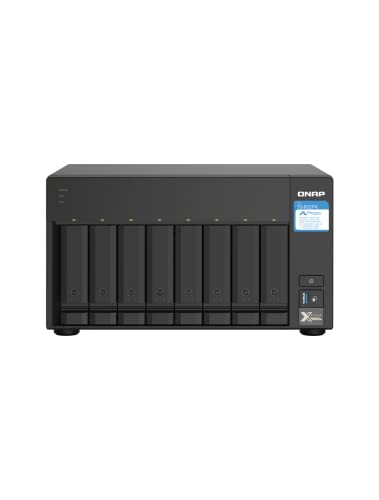
QNAP 8-Bay 10GbE Desktop NAS
Best for: high-capacity eight-bay multi-gigabit local storage
- Network Connectivity
- 5GbE, 2.5GbE, 10GbE (what this guide is about)
- Drive Bays
- 8 Bay
- Processor
- AnnapurnaLabs Alpine AL324
- RAM Capacity
- 4 GB SODIMM DDR4
- Included Storage
- Diskless
- Dimensions
- 7.4 × 13 × 11.1 inches
This 8-bay network attached storage unit gives you substantial drive capacity alongside high-speed networking. It features an AnnapurnaLabs Alpine AL324 quad-core 1.7GHz processor, 4 GB of DDR4 memory expandable to 16 GB, and dual 10GbE plus dual 2.5GbE network ports. If you need vast local storage paired with multi-gigabit throughput for backups and large file transfers across your local network, this setup fits your environment.
Pros
- Eight 3.5-inch SATA 6Gb/s drive bays
- Dual 10GbE and dual 2.5GbE network ports
- DDR4 system memory expandable up to 16 GB
- Quad-core 1.7GHz ARM Cortex-A57 processor
Cons
- Ships diskless with no internal drives included
- Base configuration includes only 4 GB of RAM
- Maximum memory ceiling capped at 16 GB
Good fit if
- You need eight drive bays for large raw storage capacity.
- You require dual 10GbE or multi-gigabit network interfaces.
- You plan to install your own 3.5-inch SATA hard drives.
Skip if
- You want a pre-populated unit with drives included.
- You require more than 16 GB of maximum system RAM.
- You prefer an Intel or AMD processor platform.
Verdict: QNAP 8-Bay Multi-Gigabit NAS delivers massive eight-bay drive capacity and fast dual 10GbE connectivity for data-intensive storage setups. It gives you flexible network speeds and room to expand your memory up to 16 GB.

QNAP 6-Bay NAS with PCIe Slots
Best for: expandable six-bay storage with port trunking
- Network Connectivity
- 5GbE, 2.5GbE (what this guide is about)
- Drive Bays
- 6 Bay
- M.2 NVMe Slots
- 2 slots
- Dimensions
- 7.4 × 10.4 × 15.1 inches
- Weight
- 15.6 pounds
This QNAP desktop enclosure gives you six drive bays and reaches 5 Gbps network speeds by port trunking its two 2.5GbE ports together. Inside, you get two M.2 NVMe SSD slots for caching or tiered storage, along with two PCIe Gen3 expansion slots that accept network cards, extra storage, or entry-level graphics cards. It suits you if you need expandable multi-bay local storage with flexible network upgrades.
Pros
- Reaches up to 5 Gbps speeds via dual 2.5GbE port trunking
- Two M.2 PCIe NVMe SSD slots for caching or Qtier
- Two PCIe Gen3 slots for adding 10GbE cards or GPUs
- Three USB 3.2 Gen 2 Type-A ports running at 10Gbps
Cons
- Requires port trunking across two cables to reach 5 Gbps
- Lacks a dedicated native 5GbE or 10GbE port out of the box
Good fit if
- You have a network setup supporting port trunking across two 2.5GbE links.
- You want six drive bays alongside two M.2 NVMe slots for SSD caching.
- You plan to add PCIe expansion cards like 10GbE adapters or dedicated GPUs.
Skip if
- You want a single native 5GbE port without combining multiple network connections.
- You need a smaller desktop enclosure with fewer than six bays.
Verdict: QNAP 6-Bay NAS with Dual 2.5GbE and PCIe provides six drive bays and achieves 5 Gbps throughput through dual-port trunking. Its two PCIe Gen3 and dual M.2 NVMe slots give you solid expansion options for faster networking and caching.

QNAP 8-Bay Rackmount AMD Ryzen NAS
Best for: 8-bay rackmount setups with 2.5GbE
- Network Connectivity
- 5GbE, 2.5GbE (what this guide is about)
- Drive Bays
- 8 Bay
- Processor
- AMD Ryzen Embedded V1500B
- RAM Capacity
- 4GB DDR4 RAM
- Included Storage
- Diskless
- Form Factor
- Rackmount
This 8-bay rackmount NAS features an AMD Ryzen V1500B processor and 4GB of DDR4 RAM. It includes dual 2.5GbE ports for fast file sharing. The unit supports PCIe expansion and offers multiple USB 3.2 ports. It suits teams needing high-speed transfers and scalable storage in a short-depth rackmount form factor.
Pros
- AMD Ryzen Embedded V1500B 4-core processor
- Dual 2.5GbE network ports
- Expandable to 64GB RAM
- Multiple USB 3.2 Gen 2 ports
Cons
- Limited to 4GB base RAM
- No 10GbE ports included
- Single power supply option
Good fit if
- You need an 8-bay capacity in a rackmount chassis
- You require dual 2.5GbE connectivity
- You want AMD Ryzen processing power
Skip if
- You need 10GbE network speeds
- You require redundant power supplies
- You prefer a desktop form factor
Verdict: QNAP TS-873AeU 8-Bay Rackmount NAS is a solid choice for users needing an 8-bay AMD Ryzen system with dual 2.5GbE ports. It fits well in short-depth racks where expandability matters.

QNAP 4-Bay 2.5GbE Desktop NAS
Best for: four-bay home media and local backups
- Network Connectivity
- 5GbE, 2.5GbE (what this guide is about)
- Drive Bays
- 4 Bay
- Processor
- ARM Cortex-A55 quad-core 2.0GHz
- RAM Capacity
- 4 GB DDR4
- Included Storage
- Diskless
- Dimensions
- 6.3 × 8.62 × 6.65 inches
This four-bay unit gives you centralized data management powered by an ARM Cortex-A55 quad-core 2.0GHz processor and 4 GB of DDR4 memory. For physical connections, the chassis includes one 2.5GbE port alongside one 1GbE port for local transfers. You can set up automated computer backups using NetBak Replicator or Time Machine. It suits you if you need a diskless multi-bay enclosure for home media files and scheduled system backups.
Pros
- ARM Cortex-A55 quad-core 2.0GHz processor
- 4 GB DDR4 memory preinstalled
- Built-in 2.5GbE and 1GbE network ports
- Supports Time Machine and NetBak Replicator backups
Cons
- Ships diskless without preinstalled drives
- Network ports top out at 2.5GbE without native 10GbE
Good fit if
- You need four drive bays for centralized home media and file storage.
- You want native backup support for Windows NetBak Replicator and Mac Time Machine.
- You already have your own drives to fill a diskless enclosure.
Skip if
- You require built-in 10GbE networking out of the box.
- You prefer a NAS that arrives with storage drives preinstalled.
Verdict: QNAP 4-Bay Quad-Core NAS with 4GB RAM delivers quad-core ARM processing and 2.5GbE connectivity across four storage bays. It provides a straightforward diskless foundation for your household backups and multimedia library.
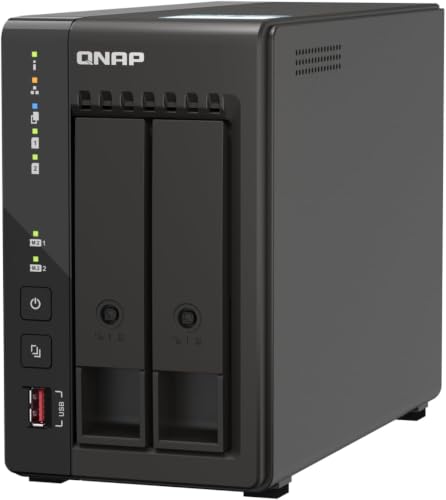
QNAP 2-Bay Desktop NAS with Dual M.2 Slots
Best for: compact dual-network media storage and SSD caching
- Network Connectivity
- 5GbE, 2.5GbE (what this guide is about)
- Drive Bays
- 2 Bay
- Processor
- Intel Celeron J6412
- RAM Capacity
- 8 GB DDR4
- M.2 NVMe Slots
- Dual M.2 PCIe Gen3x2 NVMe
- Included Storage
- Diskless
This 2-bay desktop unit features an Intel Celeron J6412 quad-core processor and 8 GB of onboard DDR4 RAM. For network connectivity, you receive dual 2.5GbE ports to accelerate file transfers across devices. Dual M.2 PCIe Gen3x2 NVMe slots support SSD cache acceleration or SSD storage pools, while USB 3.2 Gen 2 ports deliver 10Gb/s speeds. It fits you if you want a compact setup for central media storage.
Pros
- Intel Celeron J6412 quad-core processor with 2.9 GHz burst
- Dual M.2 PCIe Gen3x2 NVMe SSD slots
- Dual 2.5GbE network ports
- USB 3.2 Gen 2 Type-A ports with up to 10Gb/s transfer speeds
- 8 GB onboard DDR4 RAM
Cons
- Limited to two drive bays
- Ships diskless without included storage drives
- Onboard RAM prevents user memory upgrades
Good fit if
- You need high-speed USB 3.2 Gen 2 ports for external drive transfers.
- You want dual M.2 NVMe slots for SSD cache acceleration.
- You need a compact two-bay desktop NAS with 8 GB of memory.
Skip if
- You need more than two drive bays for high-capacity RAID arrays.
- You require hard drives included in the box.
- You want native 10GbE network interfaces.
Verdict: QNAP 2-Bay Intel Desktop NAS provides quad-core processing, dual NVMe slots, and dual 2.5GbE connectivity in a small desktop footprint.

QNAP 4-Bay 1U Short Depth Rackmount NAS
Best for: shallow racks needing multi-gigabit transfer speeds
- Network Connectivity
- 5GbE, 2.5GbE (what this guide is about)
- Drive Bays
- 4 Bay
- Processor
- Intel Celeron N5095
- RAM Capacity
- 8 GB DDR4
- M.2 NVMe Slots
- Dual M.2 PCIe Gen 3 x1 NVMe
- Included Storage
- Diskless
This QNAP unit is a 4-bay 1U short-depth rackmount NAS designed for compact server racks. It features an Intel Celeron N5095 quad-core processor, 8 GB of onboard memory, and dual 2.5GbE ports that provide high-speed networking across your network. Dual M.2 PCIe Gen 3 NVMe slots allow SSD caching or dedicated pools. It suits you if you need compact rackmount storage with fast data transfers and 4K transcoding.
Pros
- Dual 2.5GbE network ports
- Dual M.2 PCIe Gen 3 x1 NVMe SSD slots
- Intel Celeron N5095 quad-core processor
- 10Gb/s USB 3.2 Gen 2 Type-A ports
Cons
- Onboard 8 GB RAM cannot be upgraded
- HDMI 1.4b port tops out at 4K at 30Hz
- Comes diskless without hard drives included
Good fit if
- You need a compact 1U rackmount NAS for shallow equipment cabinets.
- You want dual 2.5GbE networking alongside NVMe SSD caching.
Skip if
- You need more than 8 GB of RAM for heavier workloads.
- You require 4K video output at 60Hz.
Verdict: QNAP 4-Bay 1U Short-Depth Rackmount NAS delivers multi-gigabit network speeds and NVMe caching in a shallow form factor. It provides dependable performance for compact server setups where non-expandable memory is sufficient.
Specifications side by side
| Spec | QNAP 4-Bay 10GbE SFP+ NAS | QNAP TS-264 2-Bay Desktop NAS | QNAP 16-Bay Hybrid NAS with Atom 8-Core | QNAP 8-Bay Short-Depth Rackmount NAS | QNAP 4-Bay Desktop NAS with 8GB RAM | QNAP 2-Bay 2.5GbE Desktop NAS | QNAP 9-Bay Hybrid NAS with 32GB RAM | QNAP 4-Bay Rackmount NAS with 2.5GbE | QNAP 8-Bay Rackmount NAS with Redundant Power | QNAP 8-Bay 10GbE Desktop NAS | QNAP 6-Bay NAS with PCIe Slots | QNAP 8-Bay Rackmount AMD Ryzen NAS | QNAP 4-Bay 2.5GbE Desktop NAS | QNAP 2-Bay Desktop NAS with Dual M.2 Slots | QNAP 4-Bay 1U Short Depth Rackmount NAS |
|---|---|---|---|---|---|---|---|---|---|---|---|---|---|---|---|
| Drive Bays | 4-Bay | 2 Bay | 16 Bay | 8 Bay | 4-Bay | 2-Bay | 9-Bay | 4 Bay | 8-Bay | 8 Bay | 6 Bay | 8 Bay | 4 Bay | 2 Bay | 4 Bay |
| Network Connectivity | 1x 10GbE, 1x 2.5GbE, 1x 1GbE | Dual 2.5GbE | Dual 2.5GbE | Dual 2.5GbE | Dual 2.5GbE | 2.5GbE | 2 x 2.5GbE, 1 x 10GBASE-T | Dual 2.5GbE | 2 x 2.5GbE, 2 x 10GbE SFP+ | 2 x 2.5GbE, 2 x 10GbE | 2 x 2.5GbE | Dual 2.5GbE | 1 x 2.5GbE, 1 x 1GbE | Dual 2.5GbE | Dual 2.5GbE |
| Processor | AnnapurnaLabs AL-314 | Intel Celeron N5105/N5095 | Intel Atom C-5125 | Intel Atom C5125 | Intel Pentium Gold G7400 | ARM Cortex-A55 | AMD Ryzen Embedded V1500B 2.2 GHz | Intel Quad-core | AnnapurnaLabs Alpine AL324 | AnnapurnaLabs Alpine AL324 | not specified | AMD Ryzen Embedded V1500B | ARM Cortex-A55 quad-core 2.0GHz | Intel Celeron J6412 | Intel Celeron N5095 |
| RAM Capacity | 4GB DDR3L | 8GB DDR4 | 8GB DDR4 | 8GB SODIMM DDR4 | 8GB DDR4 | 4GB DDR4 | 32GB DDR4 | 8GB RAM | 4GB UDIMM DDR4 | 4 GB SODIMM DDR4 | not specified | 4GB DDR4 RAM | 4 GB DDR4 | 8 GB DDR4 | 8 GB DDR4 |
| M.2 NVMe Slots | not specified | Dual M.2 PCIe Gen3x1 | Dual M.2 NVMe PCIe Gen 3 | Dual M.2 PCIe Gen 3 x4 NVMe SSD slots | 2 slots | not specified | not specified | Optional via PCIe | not specified | not specified | 2 slots | not specified | not specified | Dual M.2 PCIe Gen3x2 NVMe | Dual M.2 PCIe Gen 3 x1 NVMe |
| Included Storage | Diskless | Diskless | not specified | Diskless | Diskless | Diskless | not specified | not specified | Diskless | Diskless | not specified | Diskless | Diskless | Diskless | Diskless |
| Form Factor | not specified | Desktop | not specified | Rackmount | Desktop | Desktop | not specified | Rackmount | Rackmount | not specified | not specified | Rackmount | not specified | Desktop | Rackmount |
| Hardware Interface | not specified | M.2 NVMe | not specified | not specified | not specified | not specified | not specified | not specified | not specified | not specified | not specified | not specified | not specified | not specified | not specified |
| Number of Bays | 4-Bay | 2-Bay | not specified | 8-Bay | 4-Bay | 2-Bay | not specified | 4-Bay | 8-Bay | 8-Bay | 6-Bay | 8-Bay | 4-Bay | 2-Bay | 4-Bay |
| Processor Cores | not specified | Quad-Core | 8-Core | 8-Core | not specified | not specified | not specified | not specified | not specified | not specified | not specified | not specified | Quad-Core | Quad-Core | not specified |
| Dimensions | 10 × 10 × 10 inches | 13 × 9 × 11 inches | 20 × 18 × 19 inches | 23 × 21 × 8 inches | not specified | not specified | not specified | not specified | not specified | 7.4 × 13 × 11.1 inches | 7.4 × 10.4 × 15.1 inches | 3.5 × 19 × 11.7 inches | 6.3 × 8.62 × 6.65 inches | 17 × 23 × 11 inches | 12 × 12 × 12 inches |
| Weight | 5.1 pounds | 5.11 pounds | not specified | 9 pounds | not specified | not specified | not specified | not specified | not specified | 14.1 pounds | 15.6 pounds | 16.8 pounds | 4.56 pounds | not specified | 9.7 pounds |
| Size | 2.5GbE and 10GbE Ports | 2 Bay (Unav.) | 16U x 3.5" x 16" | Short Rackmount-RP (Unav.) | Intel Pentium | 2 Bay (Diskless) | 32GB RAM | not specified | 8 Bay | 8-bay (Unav.) | 6-Bay | Single Power (Unav.) | 4 Bay | 2 Bay (Unav.) | 4 bay (Unav.) |
| Color | black | Clear | Coral | Black or Gray | Black | White | not specified | not specified | not specified | Black | Black | Black | black | Black | Black |
| Model | TS-431X3 | TS-264-8G-US | TS-1655-8G-US | TS-855EU-RP-8G-US | not specified | TS-216G-US | TS-h973AX-32G-AM-US | not specified | TS-832PXU-RP-4G-AM-US | TS-832PX-4G-US | 6322837 | TS-873AEU-4G | TS-433-4G-US | TS-253E-8G | BAQN-TS-464EU-8G |
If you balance network hardware planning with outdoor utility needs, compare capacity metrics for the best horizontal storage sheds.
Selecting the Right 5GbE QNAP NAS
-
Count Your Drive Bays
Check the number of bays to meet your capacity targets and RAID redundancy plans. Dual-bay units like the QNAP 2-Bay 2.5GbE Desktop NAS fit basic storage needs with mirrored protection. Workloads requiring higher volume or parity RAID configurations benefit from four, six, or eight bays. More bays allow you to add storage incrementally without replacing existing drives right away.
-
Assess System Memory Capacity
Check installed RAM to match your multitasking requirements. Basic file serving and backups operate smoothly on 4GB setups. Intensive multi-user workloads and heavier operating systems need more memory headroom. For instance, the QNAP 6-Bay Intel Core i5 Desktop NAS includes 32GB of pre-installed RAM to handle concurrent operations. Check whether memory is fixed or expandable if you anticipate expanding your background workloads later.
-
Evaluate Processor Core Counts
Compare processor types and core counts to balance transfer throughput with background processing. Entry-level ARM chips manage simple file shares and regular scheduled backups with low power draw. Compute-heavy operations, virtualization, and heavy file indexing demand multi-core x86 processors. Choosing an eight-core CPU on units like the QNAP 8-Bay Short-Depth Rackmount NAS provides the processing speed necessary to prevent system bottlenecks during simultaneous data requests.
-
Review PCIe and M.2 Slots
Check for dedicated M.2 NVMe slots and open PCIe slots to extend your hardware capabilities. NVMe slots provide dedicated flash caching, which accelerates random input and output speeds without consuming standard 3.5-inch drive bays. PCIe Gen3 expansion slots, featured on the QNAP 6-Bay NAS with PCIe Slots, allow you to install extra interface cards. These slots keep your device adaptable as network speeds or cache requirements grow.
-
Check Power Supply Redundancy
Examine power supply specifications if continuous uptime is essential for your local network. Standard desktop and rack units rely on single power inputs, which remain vulnerable to electrical supply disruptions. Units equipped with redundant power modules, such as the QNAP 8-Bay 2U Rackmount NAS with Redundant Power, maintain operations if one power feed drops. This hardware redundancy protects ongoing transfers in critical multi-user environments.
-
Inspect Multi-Gigabit Network Ports
Match network interface options to your existing switches and cabling infrastructure. While baseline models include 2.5GbE ports that link up to 5GbE via port trunking, others combine native 5GbE, 2.5GbE, and 10GbE connections. The QNAP 8-Bay 10GbE Desktop NAS includes 10GbE SFP+ capability alongside multi-gigabit connections. Choosing hardware with flexible port configurations prevents network interfaces from throttling transfer speeds across your connected client devices.
Frequently asked questions
Which QNAP NAS has the best 5GbE networking?
The QNAP 4-Bay 10GbE SFP+ NAS offers the most versatile wired networking. It includes SFP+ and 2.5GbE interfaces alongside 5GbE support. This model serves users needing multi-gigabit throughput in a desktop enclosure. It provides flexible connectivity options for various network speeds.
Does the QNAP TS-264 support NVMe caching?
Yes, the QNAP TS-264 2-Bay Desktop NAS supports M.2 NVMe caching. It features a quad-core Intel Celeron processor for strong processing power. This unit fits users who prioritize speed and expandability over raw storage capacity. It combines 2.5GbE connectivity with high-speed caching options.
What is the largest capacity QNAP NAS with 5GbE?
The QNAP 16-Bay Hybrid NAS with Atom 8-Core offers the highest drive count. It provides 2.5GbE speeds for high-capacity storage needs. This model fits environments where 2.5GbE speeds are sufficient for the workload. It prioritizes drive count and processing power over ultra-fast 10GbE networking.
Which QNAP model is best for rackmount setups?
The QNAP 8-Bay Short-Depth Rackmount NAS is ideal for compact deployments. It delivers 8-core computing and dual NVMe caching slots. The unit includes PCIe expansion for space-constrained server racks. It fits users needing robust connectivity and drive bays in a rackmount form factor.
Can I get a QNAP NAS with 32GB of RAM?
The QNAP 9-Bay Hybrid NAS with 32GB RAM provides substantial memory. It is designed for demanding workloads like virtualization. This model prioritizes RAM capacity and 10GbE speeds over multiple 2.5GbE ports. It offers 5GbE and 2.5GbE connectivity alongside high memory for intensive tasks.
Which QNAP NAS is best for small teams?
The QNAP 4-Bay Rackmount NAS with 2.5GbE suits small teams well. It offers rackmount flexibility and dual 2.5GbE connectivity. The unit provides cloud backup features for reliable data access. It fits users who prioritize network speed and expandability over higher-end 10GbE options.
Does the QNAP 6-Bay NAS support port trunking?
Yes, the QNAP 6-Bay NAS with PCIe Slots supports port trunking. It achieves 5 Gbps throughput through dual-port configuration. The unit includes two PCIe Gen3 slots and dual M.2 NVMe slots. This provides solid expansion options for faster networking and caching capabilities.
Which QNAP NAS uses an AMD Ryzen processor?
The QNAP 8-Bay Rackmount AMD Ryzen NAS uses an AMD Ryzen processor. It features dual 2.5GbE ports for network connectivity. This model fits well in short-depth racks where expandability matters. It provides 4GB RAM and robust processing power for 8-bay setups.