Best Network Attached Storages with 2.5GbE: 15 Spec-Based Picks
As an Amazon Associate we earn from qualifying purchases. Links on this page are affiliate links.
When choosing the best network attached storages with 2 5gbe, multi-gigabit network connectivity ensures your drives transfer files without network bottlenecks. The Asustor Lockerstor 4-Bay Quad-Core NAS leads our picks because its quad-core processor, 4GB RAM, and two M.2 NVMe slots provide balanced storage performance across four drive bays.
We compared 15 models based on the specifications published on the listings. This guide helps you decide which drive bay capacity, processor configuration, and network setup best match your home or office workload.
Quick picks
The best fit for you
- You need a balanced four-bay setup with NVMe slots Asustor Lockerstor 4-Bay Quad-Core NAS It combines four storage bays with M.2 NVMe expansion and 2.5GbE connectivity for flexible local storage.
- You want 10GbE SFP+ alongside standard 2.5GbE networking QNAP 4-Bay 10GbE SFP+ NAS Dedicated 10GbE and 2.5GbE ports let you connect high-bandwidth systems directly to this four-bay unit.
- You need large rackmount capacity for enterprise storage Asustor Lockerstor 12-Bay Rackmount NAS A 12-bay rackmount chassis provides expansive drive space and 2.5GbE networking for high-capacity installations.
- You want a compact hybrid system for 2.5-inch drives LincPlus LincStation 6-Bay Hybrid 2.5-Inch NAS At 1.8 pounds, this six-bay chassis supports 2.5-inch drives and 2.5GbE connectivity in a small form factor.
Our 15 picks
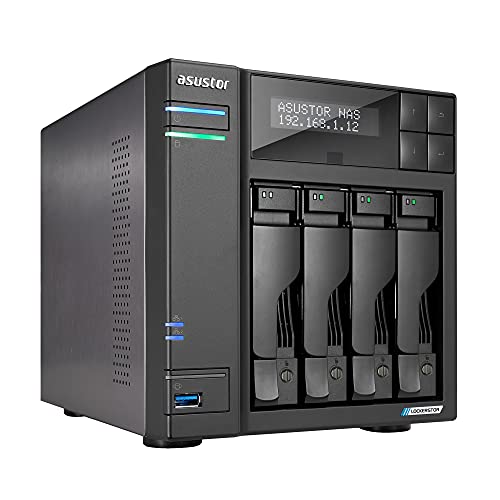
Asustor Lockerstor 4-Bay Quad-Core NAS
Best for: balanced 4-bay multi-gigabit network storage
- Network Connectivity
- 5GbE, 2.5GbE (what this guide is about)
- Drive Bays
- 4-Bay
- Processor
- Quad-Core 2.0GHz
- RAM Capacity
- 4GB DDR4
- M.2 NVMe Slots
- 2 slots
- Included Storage
- Diskless
The Asustor Lockerstor 4-Bay 2.5GbE NAS gives you four drive bays and two 2.5GbE network ports for balanced local data transfers. A 2.0GHz quad-core processor and 4GB of DDR4 memory drive the unit, while two M.2 NVMe slots allow dedicated solid-state storage. Three USB 3.2 ports handle direct peripheral backups. This desktop unit suits you if you need multi-gigabit networking alongside NVMe caching in a four-bay setup.
Pros
- Dual 2.5GbE network ports
- Two dedicated M.2 NVMe SSD slots
- Quad-core 2.0GHz processor with 4GB DDR4 memory
- Three USB 3.2 ports for external devices
- Four included IP camera licenses
Cons
- Ships diskless without pre-installed storage drives
- Base system configuration limited to 4GB RAM
- Lacks native 10GbE network ports
Good fit if
- You need dual 2.5GbE connections for multi-gigabit local file transfers.
- You want M.2 NVMe SSD caching alongside four primary drive bays.
- You plan to run up to four IP surveillance cameras without purchasing extra licenses.
Skip if
- You require native 10GbE throughput for high-bandwidth video editing.
- You need more than four drive bays for bulk data storage.
- You want a fully assembled setup that includes factory-installed hard drives.
Verdict: Asustor Lockerstor 4-Bay 2.5GbE NAS delivers dual multi-gigabit ports, quad-core processing, and two NVMe slots in a compact footprint. It provides a balanced, flexible network storage foundation for homes and small offices.

QNAP 4-Bay 10GbE SFP+ NAS
Best for: mixed 2.5GbE and 10GbE SFP+ networks
- Network Connectivity
- 5GbE, 2.5GbE, 10GbE (what this guide is about)
- Drive Bays
- 4-Bay
- Processor
- AnnapurnaLabs AL-314
- RAM Capacity
- 4GB DDR3L
- Included Storage
- Diskless
- Dimensions
- 10 × 10 × 10 inches
This 4-bay desktop NAS brings multi-gigabit networking to your storage setup with a dedicated 2.5GbE port alongside a 10GbE SFP+ connection and a standard 1GbE jack. Powered by an AnnapurnaLabs AL-314 quad-core 1.7GHz processor with 4GB of DDR3L memory, it holds four 3.5-inch SATA drives. You get flexible data paths across diverse network speeds, making it a practical choice if you manage backups across mixed-bandwidth office environments.
Pros
- Dedicated 2.5GbE, 10GbE SFP+, and 1GbE network ports
- Four 3.5-inch SATA drive bays
- Three USB 3.2 Gen 1 ports
- Memory expandable up to 8GB
Cons
- Uses older DDR3L memory architecture
- 10GbE connection uses SFP+ rather than standard copper RJ45
- Ships diskless without pre-installed storage drives
Good fit if
- You need both 2.5GbE and high-speed 10GbE SFP+ connectivity in one unit.
- You require four 3.5-inch SATA drive bays for centralized data storage.
- You want multiple USB 3.2 Gen 1 ports for external media drives.
Skip if
- You prefer modern DDR4 or DDR5 system memory.
- You need native 10GBASE-T RJ45 copper ports instead of SFP+.
Verdict: QNAP 4-Bay NAS with 10GbE and 2.5GbE delivers versatile network connectivity with its mix of 2.5GbE and 10GbE SFP+ interfaces. It offers dependable four-bay storage management for multi-speed local networks.

Asustor Lockerstor 12-Bay Rackmount NAS
Best for: high-capacity rackmount storage and virtualization environments
- Network Connectivity
- 5GbE, 2.5GbE (what this guide is about)
- Drive Bays
- 12 Bay
- Processor
- Intel Atom C3538
- RAM Capacity
- 8 GB DDR4-2133
- Included Storage
- Diskless
- Form Factor
- Rackmount
This 2U rackmount NAS gives you 12 drive bays and dual 2.5GbE ports alongside dual Gigabit Ethernet ports. An Intel Atom C3538 quad-core 2.1GHz processor drives the system, backed by 8GB of DDR4 memory expandable to 128GB across four slots. You also get a PCIe slot for adding 10GbE network cards. It suits deployment in server racks where you need multi-drive storage capacity, virtualization support, and aggregated network throughput.
Pros
- 12 drive bays in a 2U rackmount chassis
- Dual 2.5GbE and dual Gigabit ports supporting up to 5Gbps aggregated
- Four RAM slots allowing memory expansion up to 128GB
- PCIe expansion slot available for a 10GbE network card
Cons
- Requires a server rack due to its 21.1-inch depth and 25.8-pound weight
- Ships diskless without storage drives included
Good fit if
- You need 12 drive bays inside a standard server rack.
- You want dual 2.5GbE ports that support link aggregation up to 5Gbps.
- You run virtual machines or Docker containers that require up to 128GB RAM.
Skip if
- You need a compact desktop chassis instead of a rackmount unit.
- You require built-in 10GbE ports without purchasing an add-on PCIe card.
Verdict: Asustor Lockerstor 12-Bay 2U Rackmount NAS delivers 12 drive bays, multi-gigabit networking, and 128GB memory expansion for enterprise rack installations. Its open PCIe slot provides a direct hardware path to 10GbE speeds.

QNAP 4-Bay 2.5GbE Desktop NAS
Best for: home multimedia streaming and multi-device backups
- Network Connectivity
- 5GbE, 2.5GbE (what this guide is about)
- Drive Bays
- 4 Bay
- Processor
- ARM Cortex-A55 quad-core 2.0GHz
- RAM Capacity
- 4 GB DDR4
- Included Storage
- Diskless
- Dimensions
- 6.3 × 8.62 × 6.65 inches
This diskless 4-bay NAS gives you a dedicated 2.5GbE network port alongside a standard 1GbE port for mixed local network speeds. It runs on a 2.0GHz quad-core ARM Cortex-A55 processor paired with 4 GB of DDR4 RAM. If you need central storage for family photos, music, and multimedia streaming, this unit handles continuous backups from Windows via NetBak Replicator and Mac via Time Machine.
Pros
- Dedicated 2.5GbE port alongside a secondary 1GbE port
- Four drive bays for central data storage
- Quad-core 2.0GHz ARM Cortex-A55 processor with 4 GB DDR4 RAM
- Native backup support via NetBak Replicator and Time Machine
Cons
- Limited to a single 2.5GbE port
- Ships diskless with no pre-installed hard drives
Good fit if
- You need a 4-bay storage setup with a 2.5GbE network connection.
- You want dedicated backup tools for Windows and Mac computers.
Skip if
- You need dual 2.5GbE or 10GbE network interfaces.
- You want an enclosure with drives already installed.
Verdict: QNAP 4-Bay 2.5GbE Quad-Core NAS provides four bays of storage and a 2.5GbE port for home media and multi-device backups. Its ARM quad-core processor and 4 GB RAM handle routine file transfers without unnecessary network complexity.

QNAP 4-Bay 1U Short Depth Rackmount NAS
Best for: Small offices needing 2.5GbE in a rack
- Network Connectivity
- 5GbE, 2.5GbE (what this guide is about)
- Drive Bays
- 4 Bay
- Processor
- Intel Celeron N5095
- RAM Capacity
- 8 GB DDR4
- M.2 NVMe Slots
- Dual M.2 PCIe Gen 3 x1 NVMe
- Included Storage
- Diskless
This is a 4-bay rackmount NAS designed for 2.5GbE networking. It features a quad-core Intel Celeron N5095 processor and 8 GB of non-expandable DDR4 RAM. The unit includes dual M.2 NVMe slots for cache or storage pools. It supports 4K media playback via HDMI. The compact 1U short-depth form factor fits standard server racks, making it suitable for small business environments.
Pros
- Dual 2.5GbE network ports for fast file transfers
- Intel Celeron N5095 quad-core processor with 8 GB RAM
- Dual M.2 PCIe Gen 3 x1 NVMe slots
- 1U short-depth rackmount form factor
- HDMI 1.4b output for 4K media playback
Cons
- RAM is non-expandable and fixed at 8 GB
- Only one HDMI port limits multi-display setups
- Lacks 10GbE connectivity found in other list items
Good fit if
- You need a 4-bay NAS for a standard server rack
- You require dual 2.5GbE ports for network redundancy
- You want NVMe SSD caching for faster access
Skip if
- You need to upgrade RAM beyond 8 GB
- You require 10GbE SFP+ connectivity
- You prefer a desktop tower over a rackmount unit
Verdict: QNAP TS-464eU 4-Bay Rackmount NAS is a compact 1U solution for users who need dual 2.5GbE ports and NVMe support in a rackmount chassis. It fits small offices that need dedicated network speed without expanding RAM.

QNAP 8-Bay Short-Depth Rackmount NAS
Best for: 8-core rackmount storage with dual 2.5GbE
- Network Connectivity
- 5GbE, 2.5GbE (what this guide is about)
- Drive Bays
- 8 Bay
- Processor
- Intel Atom C5125
- RAM Capacity
- 8GB SODIMM DDR4
- M.2 NVMe Slots
- Dual M.2 PCIe Gen 3 x4 NVMe SSD slots
- Included Storage
- Diskless
This short-depth rackmount unit provides eight storage bays powered by an 8-core Intel Atom C5125 processor and 8GB DDR4 memory. For network transfers, you get two built-in 2.5GbE ports, plus two PCIe Gen 3 expansion slots if you need faster network cards later. Dual M.2 NVMe slots allow dedicated SSD caching. It suits you if you run multi-user environments in standard server racks requiring high compute capacity and multi-gigabit networking.
Pros
- 8-core Intel Atom C5125 processor running at 2.8GHz
- Two built-in 2.5GbE network ports
- Two M.2 PCIe Gen 3 x4 NVMe SSD slots for caching or storage pools
- Two PCIe Gen 3 x4 expansion slots for add-in cards
- Memory expandable up to 64GB with ECC RAM support
Cons
- Ships diskless without pre-installed storage drives
- Rackmount form factor requires server rack space rather than a desktop
Good fit if
- You need an 8-core processor and dual 2.5GbE ports in a rackmount form factor.
- You plan to use M.2 NVMe SSDs for cache acceleration or dedicated storage pools.
- You want PCIe Gen 3 slots available for future network card or adapter expansion.
Skip if
- You want a compact desktop unit rather than a rackmount chassis.
- You need a pre-populated NAS that includes hard drives out of the box.
Verdict: QNAP 8-Bay 8-Core Rackmount NAS combines eight drive bays with an 8-core Atom processor, dual 2.5GbE ports, and dual PCIe expansion slots. It gives your rack setup strong multi-threaded capability and flexible high-speed connectivity.

Yxk 4-Bay Intel N100 NAS
Best for: dual 2.5GbE home servers and Docker hosting
- Network Connectivity
- 5GbE, 2.5GbE (what this guide is about)
- Drive Bays
- 4-Bay
- Processor
- Intel N100
- RAM Capacity
- 8GB DDR4
- M.2 NVMe Slots
- 2 slots
- Included Storage
- Diskless
This diskless 4-bay enclosure provides dual 2.5GbE ports supporting link aggregation, an Intel N100 processor, and 8GB of DDR4 memory. You get four SATA drive bays and two M.2 NVMe slots for storage. It supports RAID 0, 1, and 5 setups along with 4K HDMI output. It suits you if you need multi-gigabit network speeds for Docker apps, local media, or backups.
Pros
- Dual 2.5GbE network ports with link aggregation support
- Intel N100 processor with low 6 W base power
- Two M.2 NVMe slots alongside four SATA drive bays
- 4K HDMI output for direct media playback
Cons
- RAID support is limited to RAID 0, 1, and 5 with no RAID 6 or 10 listed
- Ships diskless without included storage drives
Good fit if
- You want dual 2.5GbE connectivity with link aggregation for faster local transfers.
- You plan to run Docker containers or alternate operating systems like TrueNAS or Unraid.
- You need both four SATA bays and two M.2 NVMe slots for mixed storage.
Skip if
- You need advanced array configurations such as RAID 6 or RAID 10 out of the box.
- You require pre-installed hard drives ready to deploy without separate purchases.
Verdict: Yxk 4-Bay Intel N100 NAS delivers balanced dual 2.5GbE networking, low-power processing, and NVMe expansion for versatile home network storage. It gives you flexible storage layouts and direct 4K HDMI playback without requiring a subscription.

QNAP 2-Bay 2.5GbE Desktop NAS
Best for: compact home storage with 2.5GbE networking
- Network Connectivity
- 5GbE, 2.5GbE (what this guide is about)
- Drive Bays
- 2-Bay
- Processor
- ARM Cortex-A55
- RAM Capacity
- 4GB DDR4
- Included Storage
- Diskless
- Form Factor
- Desktop
The QNAP 2-Bay 2.5GbE Desktop NAS provides compact network storage for personal files and multimedia streaming. It features a quad-core 2.0GHz ARM Cortex-A55 processor paired with 4 GB of DDR4 memory. For fast local file transfers, you get a 2.5GbE port. An integrated NPU handles AI photo and object recognition. This diskless two-bay setup suits you if you want basic network backups and centralized media organization.
Pros
- 2.5GbE network port for multi-gigabit file transfers
- Quad-core 2.0GHz ARM Cortex-A55 processor with 4 GB DDR4 RAM
- Built-in NPU for AI face and object recognition acceleration
- Compact 2-bay desktop enclosure
Cons
- Ships diskless without pre-installed storage
- Limited to two drive bays for internal expansion
- Uses an ARM architecture processor rather than x86
Good fit if
- You need a compact 2-bay storage unit with 2.5GbE networking.
- You want NPU acceleration for organizing photos via face and object recognition.
- You plan to store and stream personal music, videos, and family files centrally.
Skip if
- You require more than two drive bays for high-capacity storage arrays.
- You want a turnkey NAS that includes pre-installed hard drives.
Verdict: QNAP 2-Bay 2.5GbE Desktop NAS offers an efficient entry point for multi-gigabit home backups and AI-assisted photo management. Its two-bay capacity and ARM hardware make it well suited for light domestic workloads.
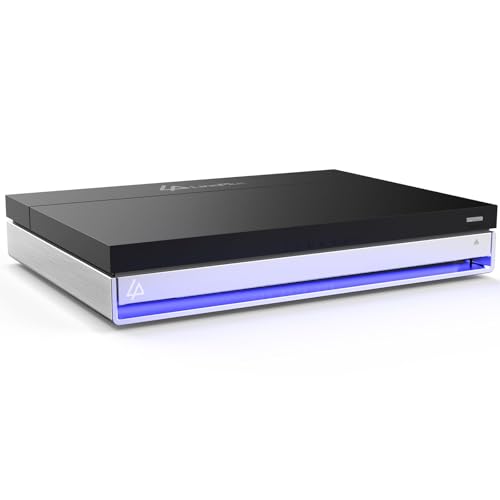
LincPlus LincStation 6-Bay Hybrid 2.5-Inch NAS
Best for: compact NVMe caching and home container servers
- Network Connectivity
- 5GbE, 2.5GbE (what this guide is about)
- Drive Bays
- 6-Bay
- Processor
- Intel N5105
- RAM Capacity
- 16GB
- M.2 NVMe Slots
- 4 slots
- Included Storage
- Diskless
View on Amazon: LincPlus LincStation 6-Bay Hybrid 2.5-Inch NAS
The LincPlus 6-Bay Hybrid NVMe NAS gives you a compact storage platform running an Intel Celeron N5105 quad-core processor with 16GB of memory. It features one 2.5GbE port for high-speed network transfers, paired with four M.2 NVMe slots and two 2.5-inch SATA bays. This setup suits you if you need fast flash storage, container hosting, and direct 4K video output.
Pros
- Four M.2 2280 NVMe slots and two 2.5-inch SATA bays
- Intel Celeron N5105 quad-core processor with 16GB RAM
- Dedicated 2.5GbE port and HDMI 2.0 4K output
- Pre-installed 128GB eMMC with Unraid Starter license
Cons
- No support for standard 3.5-inch mechanical hard drives
- Single network interface without a secondary Ethernet port
Good fit if
- You want multiple M.2 NVMe SSD slots in a small desktop form factor.
- You need 16GB of system memory for Docker containers and applications.
- You prefer an included Unraid operating system license out of the box.
Skip if
- You require 3.5-inch drive bays for high-capacity bulk hard drives.
- You need dual network ports for link aggregation or failover.
Verdict: LincPlus 6-Bay Hybrid NVMe NAS delivers balanced 2.5GbE networking, four NVMe slots, and 16GB RAM for compact home server workloads. It provides a flexible Unraid foundation if you do not require standard 3.5-inch hard drive bays.

QNAP 8-Bay 2U Rackmount NAS with Redundant Power
Best for: rackmount multi-gigabit storage with power redundancy
- Network Connectivity
- 5GbE, 2.5GbE, 10GbE (what this guide is about)
- Drive Bays
- 8-Bay
- Processor
- AnnapurnaLabs Alpine AL324 1.7GHz
- RAM Capacity
- 4GB UDIMM DDR4
- Included Storage
- Diskless
- Form Factor
- Rackmount
View on Amazon: QNAP 8-Bay 2U Rackmount NAS with Redundant Power
This 2U rackmount unit pairs eight 3.5-inch SATA drive bays with two 2.5GbE ports and two 10GbE SFP+ ports. Powered by a quad-core 1.7GHz ARM processor and 4GB DDR4 memory, it handles multi-gigabit storage arrays. Redundant power supplies provide hardware failover. It fits your rack setup if you need high-capacity network storage with dual multi-gigabit copper and high-speed fiber links.
Pros
- Two 2.5GbE ports and two 10GbE SFP+ ports
- Eight 3.5-inch SATA drive bays
- Dual redundant power supplies
- One PCIe Gen 2 x2 expansion slot
Cons
- Ships with 4GB RAM and caps at 16GB
- PCIe interface limited to Gen 2 x2 bandwidth
- 2U rackmount chassis requires server cabinet installation
Good fit if
- You need an 8-bay rackmount enclosure with redundant power.
- You run a network utilizing both 2.5GbE copper and 10GbE SFP+ fiber connections.
Skip if
- You need a compact desktop enclosure instead of a rackmount.
- You require an x86 processor architecture for your applications.
Verdict: QNAP 8-Bay 2U Rackmount NAS with Redundant Power delivers dual 2.5GbE and dual 10GbE SFP+ connectivity in a rack-ready chassis. It provides hardware redundancy and multi-gigabit speeds for standard server setups.
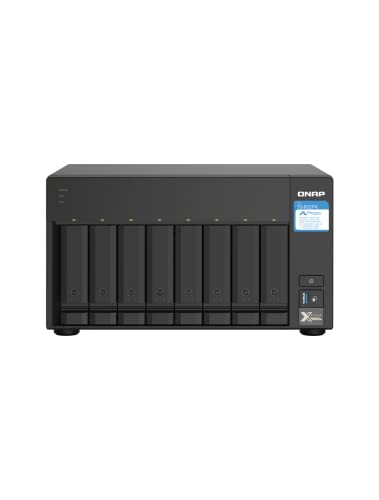
QNAP 8-Bay 10GbE Desktop NAS
Best for: high-capacity multi-gigabit network storage
- Network Connectivity
- 5GbE, 2.5GbE, 10GbE (what this guide is about)
- Drive Bays
- 8 Bay
- Processor
- AnnapurnaLabs Alpine AL324
- RAM Capacity
- 4 GB SODIMM DDR4
- Included Storage
- Diskless
- Dimensions
- 7.4 × 13 × 11.1 inches
This QNAP desktop unit delivers high-capacity storage through eight 3.5-inch SATA drive bays. For network connections, you get two 2.5GbE ports alongside two 10GbE ports. It runs on an AnnapurnaLabs Alpine AL324 quad-core 1.7GHz processor with 4 GB DDR4 memory, expandable up to 16 GB. It suits you if you need bulk local storage and multi-gigabit throughput across several networked workstations without adding expansion cards.
Pros
- Two 2.5GbE and two 10GbE network ports
- Eight 3.5-inch SATA drive bays
- Memory expands from 4 GB up to 16 GB
Cons
- Ships diskless without pre-installed storage
- Base system includes 4 GB RAM
- Processor clocks at 1.7GHz
Good fit if
- You need eight 3.5-inch SATA bays for bulk disk capacity.
- You run mixed 2.5GbE and 10GbE network environments.
Skip if
- You need factory-installed hard drives ready out of the box.
- You require more than 16 GB maximum system memory.
Verdict: QNAP 8-Bay 2.5GbE and 10GbE NAS provides expansive eight-bay storage with built-in multi-gigabit connectivity. It balances capacity and network speeds for bandwidth-demanding local backup setups.
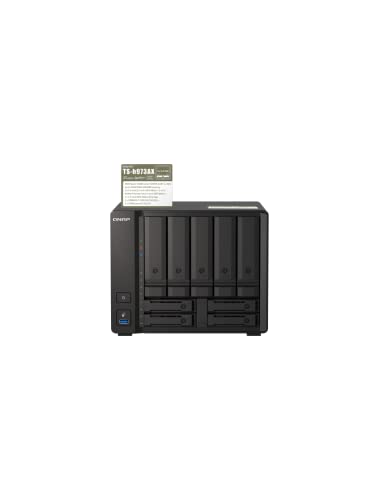
QNAP 9-Bay Hybrid Multi-Gigabit NAS
Best for: hybrid high-capacity multi-gigabit network storage
- Network Connectivity
- 5GbE, 2.5GbE, 10GbE (what this guide is about)
- Drive Bays
- 9-Bay
- Processor
- AMD Ryzen Embedded V1500B 2.2 GHz
- RAM Capacity
- 8GB DDR4
- Dimensions
- 8.82 × 8.82 × 7.17 inches
- Weight
- 10.4 pounds
This 9-bay desktop NAS is built around an AMD Ryzen Embedded V1500B quad-core processor and flexible multi-gigabit connectivity. You get two 2.5GbE ports alongside a dedicated 10GBASE-T port for high-bandwidth data transfers. With nine hybrid drive bays and expandable memory supporting up to 64GB ECC RAM, it provides ample scale. It suits you if you manage massive data volumes across mixed drive tiers and require fast multi-gigabit networking.
Pros
- Two 2.5GbE ports plus one 10GBASE-T port
- Nine hybrid drive bays for flexible storage capacity
- AMD Ryzen Embedded V1500B quad-core 2.2 GHz processor
- RAM expandable up to 64GB with optional ECC support
- USB 3.2 Gen 2 Type-C and Type-A ports
Cons
- Base configuration includes only 8GB of RAM
- Substantial desktop footprint weighing 10.4 pounds
- No integrated HDMI display output
Good fit if
- You need both 2.5GbE and 10GBASE-T Ethernet connectivity.
- You want a 9-bay system with hybrid drive configurations.
- You plan to upgrade memory to 64GB ECC RAM.
Skip if
- You only require a compact two-bay or four-bay NAS.
- You need direct HDMI output for local multimedia playback.
Verdict: QNAP 9-Bay Ryzen Desktop NAS pairs dual 2.5GbE and 10GBASE-T networking with a 9-bay hybrid layout. It delivers serious capacity and bandwidth for demanding local network environments.

QNAP 6-Bay NAS with PCIe Slots
Best for: six-bay storage with PCIe expandability
- Network Connectivity
- 5GbE, 2.5GbE (what this guide is about)
- Drive Bays
- 6 Bay
- M.2 NVMe Slots
- 2 slots
- Dimensions
- 7.4 × 10.4 × 15.1 inches
- Weight
- 15.6 pounds
This QNAP desktop unit provides six drive bays and two 2.5GbE network ports. You can link both Ethernet connections with port trunking to reach transfer rates up to 5 Gbps. Internal expansion includes two M.2 PCIe NVMe slots for SSD caching alongside two PCIe Gen3 slots for add-in cards. It suits you if you need six-bay storage capacity combined with multi-gigabit networking and PCIe upgrade options.
Pros
- Two 2.5GbE ports supporting port trunking up to 5 Gbps
- Two PCIe Gen3 expansion slots
- Two M.2 PCIe NVMe SSD slots for SSD caching or Qtier
- Three 10Gbps USB 3.2 Gen 2 Type-A ports
Cons
- Lacks built-in 10GbE network ports out of the box
- Weighs 15.6 pounds without drives installed
Good fit if
- You want 2.5GbE connectivity with the option to bond ports for up to 5 Gbps.
- You plan to add PCIe cards or dedicated M.2 NVMe SSD caching.
- You need six drive bays in a desktop footprint.
Skip if
- You require native 10GbE ports without purchasing an add-in PCIe card.
- You need a smaller two-bay or four-bay storage footprint.
Verdict: QNAP 6-Bay 2.5GbE NAS with PCIe Slots delivers dual 2.5GbE networking alongside flexible internal slots for NVMe caching and PCIe upgrades. It offers a balanced hardware foundation if your storage setup demands six bays and modular multi-gigabit capability.
Asustor Lockerstor 4-Bay NAS with 4 M.2 NVMe Slots
Best for: dual 2.5GbE networking with extensive NVMe caching
- Network Connectivity
- 5GbE, 2.5GbE, 10GbE (what this guide is about)
- Drive Bays
- 4-Bay
- Processor
- Intel Celeron N5105
- RAM Capacity
- 4GB DDR4
- M.2 NVMe Slots
- 4 slots
- Included Storage
- No Drive
View on Amazon: Asustor Lockerstor 4-Bay NAS with 4 M.2 NVMe Slots
The Asustor Lockerstor 4 Gen2 4-Bay NAS gives you two 2.5GbE network ports with link aggregation support. It runs on an Intel Celeron N5105 quad-core processor with 4GB of DDR4 memory. You also get four M.2 NVMe SSD slots for caching or storage acceleration, plus a PCIe expansion slot. It suits you if you need multi-gigabit networking, fast local backups, and 4K hardware transcoding.
Pros
- Dual 2.5GbE ports with link aggregation support
- Four M.2 NVMe slots for caching or storage pools
- PCIe slot allows optional 10GbE network card upgrades
- Intel Celeron N5105 processor supports 4K hardware transcoding
Cons
- Ships without any included hard drives
- Base configuration includes 4GB of RAM
- 10GbE speeds require a separate PCIe add-in card
Good fit if
- You need dual 2.5GbE ports for aggregated network speeds.
- You want up to four M.2 NVMe SSDs for high-speed caching.
- You plan to stream media with 4K hardware transcoding.
Skip if
- You want a NAS with storage drives already installed.
- You need built-in 10GbE ports without adding an expansion card.
Verdict: Asustor Lockerstor 4 Gen2 4-Bay NAS combines dual 2.5GbE ports with extensive expansion options across four M.2 NVMe slots and a PCIe slot. It is a capable platform when you want multi-gigabit speeds and dedicated SSD caching.
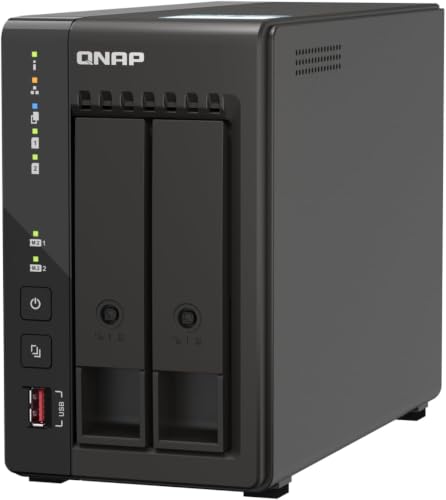
QNAP 2-Bay Desktop NAS with Dual M.2 Slots
Best for: Compact 2.5GbE setups needing M.2 caching
- Network Connectivity
- 5GbE, 2.5GbE (what this guide is about)
- Drive Bays
- 2 Bay
- Processor
- Intel Celeron J6412
- RAM Capacity
- 8 GB DDR4
- M.2 NVMe Slots
- Dual M.2 PCIe Gen3x2 NVMe
- Included Storage
- Diskless
QNAP 2-Bay Intel Celeron 2.5GbE Desktop NAS gives you a compact network storage setup built around an Intel Celeron J6412 quad-core processor. Two 2.5GbE ports handle high-speed data transfers across your local network. Dual M.2 PCIe Gen3x2 NVMe slots support dedicated cache acceleration or fast SSD pools. With 8 GB of DDR4 memory and 10 Gbps USB 3.2 Gen 2 ports, this unit suits compact multi-gigabit setups requiring solid media processing.
Pros
- Dual 2.5GbE network ports
- Intel Celeron J6412 quad-core CPU up to 2.9 GHz
- Dual M.2 PCIe Gen3x2 NVMe SSD slots
- USB 3.2 Gen 2 ports with 10Gbps transfer speed
- 8 GB DDR4 onboard memory
Cons
- Two 3.5-inch drive bays limit internal drive capacity
- Onboard RAM prevents memory expansion
- Ships diskless without pre-installed storage drives
Good fit if
- You need dual 2.5GbE networking paired with an Intel Celeron CPU.
- You want NVMe SSD caching alongside two primary drive bays.
- You connect external high-speed storage via 10Gbps USB 3.2 Gen 2.
Skip if
- You need more than two primary storage drive bays.
- You require expandable RAM beyond the fixed 8 GB onboard.
Verdict: QNAP 2-Bay Intel Celeron 2.5GbE Desktop NAS combines dual 2.5GbE ports, dual M.2 NVMe slots, and an efficient Celeron processor in a space-saving two-bay chassis.
Specifications side by side
| Spec | Asustor Lockerstor 4-Bay Quad-Core NAS | QNAP 4-Bay 10GbE SFP+ NAS | Asustor Lockerstor 12-Bay Rackmount NAS | QNAP 4-Bay 2.5GbE Desktop NAS | QNAP 4-Bay 1U Short Depth Rackmount NAS | QNAP 8-Bay Short-Depth Rackmount NAS | Yxk 4-Bay Intel N100 NAS | QNAP 2-Bay 2.5GbE Desktop NAS | LincPlus LincStation 6-Bay Hybrid 2.5-Inch NAS | QNAP 8-Bay 2U Rackmount NAS with Redundant Power | QNAP 8-Bay 10GbE Desktop NAS | QNAP 9-Bay Hybrid Multi-Gigabit NAS | QNAP 6-Bay NAS with PCIe Slots | Asustor Lockerstor 4-Bay NAS with 4 M.2 NVMe Slots | QNAP 2-Bay Desktop NAS with Dual M.2 Slots |
|---|---|---|---|---|---|---|---|---|---|---|---|---|---|---|---|
| Drive Bays | 4-Bay | 4-Bay | 12 Bay | 4 Bay | 4 Bay | 8 Bay | 4-Bay | 2-Bay | 6-Bay | 8-Bay | 8 Bay | 9-Bay | 6 Bay | 4-Bay | 2 Bay |
| Network Connectivity | 2x 2.5GbE | 1x 10GbE, 1x 2.5GbE, 1x 1GbE | not specified | 1 x 2.5GbE, 1 x 1GbE | Dual 2.5GbE | Dual 2.5GbE | 2 x 2.5GbE | 2.5GbE | 2.5GbE | 2 x 2.5GbE, 2 x 10GbE SFP+ | 2 x 2.5GbE, 2 x 10GbE | 2 x 2.5GbE, 1 x 10GBASE-T | 2 x 2.5GbE | Dual 2.5GbE | Dual 2.5GbE |
| Processor | Quad-Core 2.0GHz | AnnapurnaLabs AL-314 | Intel Atom C3538 | ARM Cortex-A55 quad-core 2.0GHz | Intel Celeron N5095 | Intel Atom C5125 | Intel N100 | ARM Cortex-A55 | Intel N5105 | AnnapurnaLabs Alpine AL324 1.7GHz | AnnapurnaLabs Alpine AL324 | AMD Ryzen Embedded V1500B 2.2 GHz | not specified | Intel Celeron N5105 | Intel Celeron J6412 |
| RAM Capacity | 4GB DDR4 | 4GB DDR3L | 8 GB DDR4-2133 | 4 GB DDR4 | 8 GB DDR4 | 8GB SODIMM DDR4 | 8GB DDR4 | 4GB DDR4 | 16GB | 4GB UDIMM DDR4 | 4 GB SODIMM DDR4 | 8GB DDR4 | not specified | 4GB DDR4 | 8 GB DDR4 |
| M.2 NVMe Slots | 2 slots | not specified | not specified | not specified | Dual M.2 PCIe Gen 3 x1 NVMe | Dual M.2 PCIe Gen 3 x4 NVMe SSD slots | 2 slots | not specified | 4 slots | not specified | not specified | not specified | 2 slots | 4 slots | Dual M.2 PCIe Gen3x2 NVMe |
| Included Storage | Diskless | Diskless | Diskless | Diskless | Diskless | Diskless | Diskless | Diskless | Diskless | Diskless | Diskless | not specified | not specified | No Drive | Diskless |
| RAID Support | not specified | not specified | not specified | not specified | not specified | not specified | RAID 0, 1, 5 | not specified | not specified | not specified | not specified | not specified | not specified | not specified | not specified |
| Form Factor | not specified | not specified | Rackmount | not specified | Rackmount | Rackmount | not specified | Desktop | 2.5 Inch | Rackmount | not specified | not specified | not specified | not specified | Desktop |
| Hardware Interface | M.2 NVMe | not specified | not specified | not specified | not specified | not specified | HDMI | not specified | SATA, HDMI | not specified | not specified | not specified | not specified | M.2 NVMe | not specified |
| Number of Bays | 4-Bay | 4-Bay | 12-Bay | 4-Bay | 4-Bay | 8-Bay | 4-Bay | 2-Bay | 6-Bay | 8-Bay | 8-Bay | not specified | 6-Bay | 4-Bay | 2-Bay |
| Processor Cores | Quad-Core | not specified | Quad-Core | Quad-Core | not specified | 8-Core | not specified | not specified | not specified | not specified | not specified | not specified | not specified | Quad-Core | Quad-Core |
| Dimensions | 9.06 × 6.69 × 7.3 inches | 10 × 10 × 10 inches | 21.1 × 17.3 × 3.46 inches | 6.3 × 8.62 × 6.65 inches | 12 × 12 × 12 inches | 23 × 21 × 8 inches | 9.2 × 7.9 × 6.3 inches | not specified | 5.9 × 8.2 × 1.5 inches | 23 × 20 × 5 inches | 7.4 × 13 × 11.1 inches | 8.82 × 8.82 × 7.17 inches | 7.4 × 10.4 × 15.1 inches | 9.45 × 12.6 × 11.8 inches | 17 × 23 × 11 inches |
| Weight | 6.53 pounds | 5.1 pounds | 25.8 pounds | 4.56 pounds | 9.7 pounds | 9 pounds | 7.84 pounds | not specified | 1.8 pounds | 4.41 pounds | 14.1 pounds | 10.4 pounds | 15.6 pounds | 7.72 pounds | not specified |
| Size | 4 Bay | 2.5GbE and 10GbE Ports | 5.5"(W) x 7.5"(H) x 9.1"(D) | 4 Bay | 4 bay (Unav.) | Short Rackmount-RP (Unav.) | 4-Bay | 2 Bay (Diskless) | not specified | 8 Bay (Unav.) | 8-bay (Unav.) | 8GB RAM (Unav.) | 6-Bay | 4 Bay | 2 Bay (Unav.) |
| Color | AS6604T | black | AS6512RD | black | Black | Black or Gray | Black | White | not specified | black | Black | black | Black | Lockerstor Gen2 | Black |
| Model | AS6604T | TS-431X3 | AS6512RD | TS-433-4G-US | BAQN-TS-464EU-8G | TS-855EU-RP-8G-US | not specified | TS-216G-US | LincStation N1 | TS-832PXU-RP-4G-US | TS-832PX-4G-US | TS-h973AX-8G | 6322837 | 116436 | TS-253E-8G |
To match these transfer rates on your PC, you can compare the best motherboards with 2 5gbe by their hardware specifications.
How to Choose a 2.5GbE NAS
-
Check RAM Capacity and Overhead
Check installed system memory before buying. Basic multi-gigabit file transfers run smoothly on 4GB RAM. Running container apps or handling multiple users requires 8GB RAM or more. Heavy multitasking exhausts low memory and limits performance. Check whether the motherboard supports memory expansion or uses fixed chips. The QNAP 2-Bay Desktop NAS with Dual M.2 Slots ships with 8GB RAM, which provides headroom for running background tasks alongside standard multi-gigabit backups. Match memory size to your software services.
-
Evaluate Processor Core Count
Examine the central processor specifications. Routine data storage and scheduled backups require only entry-level ARM or dual-core chips. Heavier workloads like virtualization, encryption, and multi-user access demand quad-core or 8-core processors to prevent transfer bottlenecks over 2.5GbE connections. Multi-threaded software distributes operations across extra processing cores to maintain consistent network throughput. The QNAP 8-Bay Short-Depth Rackmount NAS provides an 8-core processor to sustain dense data requests across business networks. Verify processing core numbers match your intended service workload.
-
Inspect NVMe SSD Caching
Look at internal M.2 NVMe slot counts. Fast 2.5GbE transfers can exceed standard mechanical hard drive write speeds during random file access. Dedicated NVMe slots let you add solid-state cache without consuming primary drive bays. This setup accelerates frequent file reads and database queries while leaving all main bays available for high-capacity drives. The Asustor Lockerstor 4-Bay NAS with 4 M.2 NVMe Slots includes four dedicated slots for high-speed cache volumes. Select models with dedicated NVMe interfaces if your workload involves frequent small files.
-
Verify Drive Bay Form Factor
Confirm supported drive physical sizes before purchasing. Most network storage units accept standard 3.5-inch hard drives alongside 2.5-inch solid-state disks. However, compact units restrict internal bays to smaller 2.5-inch SATA or solid-state media exclusively. Standard 3.5-inch drives offer maximum raw storage per bay, whereas 2.5-inch designs prioritize lower power consumption and smaller footprints. The LincPlus LincStation 6-Bay Hybrid 2.5-Inch NAS requires compact 2.5-inch SATA drives instead of 3.5-inch hard disks. Check whether your existing or planned drive inventory physically matches the enclosure bay dimensions.
-
Check PCIe Expansion Options
Review internal PCIe expansion slot availability. A 2.5GbE interface delivers solid baseline multi-gigabit throughput, but future upgrades may require faster connectivity. Integrated PCIe slots let you install add-in cards for 10GbE network cards, extra M.2 storage cards, or wireless adapters down the line. Units without expansion slots remain locked to their factory network speeds and internal interfaces. The QNAP 6-Bay NAS with PCIe Slots includes internal expansion bays for modular hardware additions. Choose an enclosure with open PCIe connectivity if you plan to upgrade network interfaces later.
-
Consider Direct Video Output
Determine whether you require direct display hardware. Standard units operate purely headless across the local network, managed solely through web browser interfaces. Enclosures featuring built-in HDMI ports can connect straight to monitors or televisions. This allows direct media playback, direct terminal management, or surveillance monitoring without streaming across network cables. The Yxk 4-Bay Intel N100 NAS provides an integrated HDMI hardware interface for direct 4K output to local screens. Select a model with display ports if you need local audiovisual output without streaming over network connections.
Frequently asked questions
Do you need special Ethernet cables for a 2.5GbE NAS?
Standard Cat5e network cables work with 2.5GbE NAS devices over distances up to 100 meters. You do not need to rewire your home or office if you already have Cat5e or Cat6 installed. Upgrading to shielded Cat6 or Cat6a cabling can reduce interference in dense installations, but basic Cat5e reliably delivers full 2.5Gbps bandwidth.
Can you connect a 2.5GbE NAS to a 10GbE network?
Yes, 2.5GbE ports automatically negotiate down to match multi-gigabit ports on compatible 10GbE switches. Several models in our guide also integrate dedicated 10GbE hardware alongside 2.5GbE. For instance, the QNAP TS-431X3 includes a 10GbE SFP+ port, and the QNAP TS-h973AX features built-in 10GBASE-T networking to interface directly with higher-speed corporate backbones.
What processor options are available on 2.5GbE NAS devices?
Processors range from efficient low-power chips to multi-core desktop processors. Entry-level units like the QNAP TS-433 use quad-core ARM chips for simple file operations. Mid-range units like the QNAP TS-253E and Yxk 4-Bay feature quad-core Intel Celeron and N100 processors. For higher computing demands, the QNAP TS-855EU-RP provides an 8-core CPU, while the TVS-h674 includes an Intel Core i5.
Which 2.5GbE NAS models offer direct HDMI video output?
Both the Yxk 4-Bay Intel N100 NAS and the LincPlus LincStation N1 feature integrated HDMI ports. This physical interface allows you to connect the device straight to an external monitor, television, or local display setup. Direct HDMI connections let you stream 4K media directly or manage system interfaces locally without routing all display traffic across your network.
Are all 2.5GbE NAS units designed for standard 3.5-inch hard drives?
No, certain compact models use smaller storage media. While most tower and rackmount models accommodate standard 3.5-inch hard drives, the LincPlus LincStation N1 is a 2.5-inch form factor device. It features six bays configured for 2.5-inch SATA drives and four internal M.2 NVMe slots, making it smaller and lighter than conventional 3.5-inch multi-bay enclosures.
How many M.2 NVMe slots can you get on a 2.5GbE NAS?
M.2 slot counts vary significantly across different chassis designs. The Asustor Lockerstor 4-Bay AS6604T and QNAP TS-253E each supply two internal M.2 NVMe slots for solid-state storage. If your workload requires heavier SSD caching, the Asustor Lockerstor 4 Gen2 provides four M.2 NVMe slots alongside its four standard drive bays and dual 2.5GbE network ports.
Can you get redundant power supplies on a 2.5GbE rackmount NAS?
Yes, select multi-gigabit rackmount units include built-in redundant power configurations. The QNAP TS-832PXU-RP-4G-US and the short-depth QNAP TS-855EU-RP-8G-US both offer dual power supplies within their rack chassis. This hardware design maintains continuous uptime by keeping your network storage running seamlessly if one power source or internal power module experiences a failure.